The USP Verified Mark is the only supplement seal you can check against a published list in under a minute. USP maintains a searchable listing of every product it has verified. If the bottle in your hand is not in that listing, under that exact brand, product name and dosage form, the artwork on the label is decoration. Most packages that mention USP never claim verification at all.
How do I verify a USP Verified mark on a supplement?
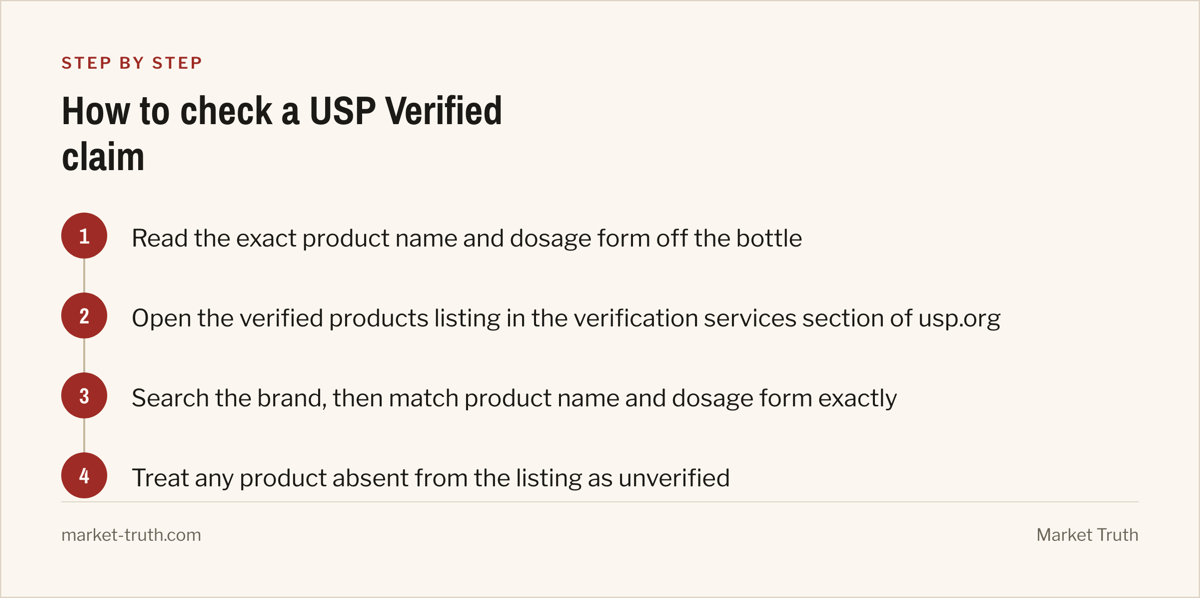
Match the package to USP’s published listing of verified products, reachable from the verification services section of usp.org. Read the exact product name and dosage form off the label first. Then search the brand and confirm the same dosage form appears. A verified capsule tells you nothing about the gummy sold beside it.
Verification is granted to a specific finished product, not to a brand and not to an ingredient. According to U.S. Pharmacopeia, the program includes a manufacturing facility audit, a review of manufacturing and quality control documentation, laboratory testing of samples, and off-the-shelf retesting of products already carrying the mark. That last step is what separates verification from a one-time certificate. USP states the mark has appeared on more than 700 million labels and packages since the program began.
The practical consequence is narrow. A brand with one verified multivitamin can put “USP Verified” language across its website while selling nine unverified products. The listing, not the packaging, is the authority. That is also why a screenshot of a seal in a marketplace product image proves nothing on its own.
What does a genuine USP Verified listing actually confirm?
Four things, and they are all about the contents of the container. USP states the mark indicates the product contains the ingredients listed on the label in the declared potency and amounts, does not contain harmful levels of specified contaminants, will break down and release within a specified time, and was made according to FDA current good manufacturing practices.
Those four points map onto the questions consumers actually have. Potency answers whether the dose on the panel is the dose in the capsule. Contaminant limits cover heavy metals and similar adulterants. Disintegration answers whether the tablet dissolves at all, which is a real failure mode for compressed tablets.
The audit standard is named, which matters. USP audits against its own General Chapter 2750 and against 21 CFR Part 111, the federal current good manufacturing practice rule for dietary supplements. A seal that names its standard can be argued with. A seal that names nothing cannot. This is the same reasoning behind checking a dose against the amount actually studied rather than accepting a summary of the research, set out in how to tell if a supplement works, and it is why we treat named standards as the minimum bar in any third-party testing claim.
Is “made to USP standards” the same as USP Verified?
No, and the gap is the single most exploited ambiguity on supplement packaging. USP Verified means USP audited the plant and tested that finished product. “USP grade”, “meets USP standards” or “USP monograph quality” is the manufacturer’s own representation about an ingredient specification. No audit, no listing, no seal.
The representation is not meaningless in law. Under 21 U.S.C. 343(s)(2)(D), a dietary supplement is misbranded if it is covered by the specifications of an official compendium, is represented as conforming to those specifications, and fails to so conform. Subsection (s)(2)(E) covers products outside a compendium: they are misbranded if they fail to have the identity and strength represented, or fail to meet the quality, purity or compositional specifications they are represented to meet.
So the phrase creates an obligation. What it does not create is evidence. Nobody tested the finished bottle, and no third party publishes a record you can search.
| Wording on the package | What it actually covers | Where you verify it |
|---|---|---|
| USP Verified, with the mark | Facility audit, finished product testing, off-the-shelf retesting of that product | USP’s published listing of verified products |
| USP grade, or meets USP standards | The firm’s own representation that a specification is met | Nowhere public. Enforced only after the fact under 21 U.S.C. 343(s)(2) |
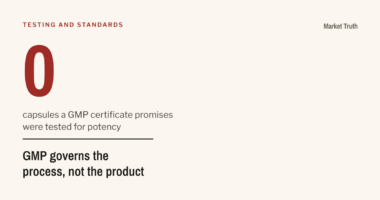
| Manufactured in a GMP facility | A process claim about the plant, not the capsule | Not checkable from the label unless the auditor is named |
| FDA registered facility | A filing obligation, not a review | FDA’s registration record, which shows only that a filing exists |
How do I spot a lookalike USP seal on a marketplace listing?
Read the words inside the seal before looking at the shape. Counterfeit and lookalike marks almost never say “USP Verified” outright, because that specific phrase is the checkable one. They say “USP tested”, “USP certified”, “pharmacopoeia grade” or they use a circular badge with no organisation named at all.
Three checks settle it. First, the exact wording: only “USP Verified” corresponds to the program. Second, the listing: search the product name and dosage form. Third, the seller: marketplace listings are frequently assembled by third-party sellers who reuse manufacturer images across variants that were never verified.
The FTC treats all of this as advertising. The Health Products Compliance Guidance states expressly that its definition of advertising includes packaging and labeling, websites, social media and influencer marketing. The FTC’s operating rule is that marketers of health-related products must have at least the level of support that they claim to have. A seal is a claim of support, so an unverifiable seal is an unsupported claim.
Why would a good supplement be missing from the USP listing?
Because verification is voluntary and nothing in federal law requires it. Part 111 sets manufacturing obligations and 21 CFR 101.93 sets the structure/function disclaimer. Neither rule mentions independent verification, so absence from the USP listing is not evidence of a defective product. It is evidence that the brand did not enter the program.
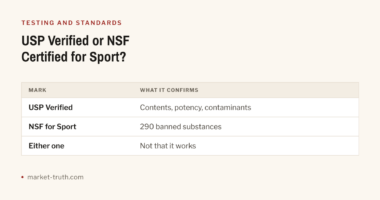
USP is also not the only program that publishes per-product results. NSF Certified for Sport verifies that products do not contain any of 290 substances banned by major athletic organizations, that contents match the label, and that the facility is GMP-certified and audited annually or bi-annually, working to NSF/ANSI 173 and NSF 229. ConsumerLab tests products, where possible, for identity, strength, purity and disintegration, and requires seal products to be retested every twelve months from a randomly purchased open-market sample.
So the sensible reading of an absent listing is a shrug, not an accusation. Check the other two programs before concluding a product is untested. What you should not do is accept the brand’s own word in place of any of the three.
What if a brand claims USP verification the listing does not show?
Treat the mismatch as the finding. A verification claim that the verifier’s own listing does not confirm is the clearest signal available on a supplement page, clearer than an ingredient panel and clearer than a review score. Screenshot the claim, note the product name and dosage form, and stop there.
Two federal mechanisms cover it. The FTC’s standing rule is that marketers must have at least the level of support they claim to have, and its definition of advertising expressly reaches packaging, labeling, websites and social media. Separately, a supplement represented as conforming to an official compendium that fails to so conform is misbranded under 21 U.S.C. 343(s)(2)(D). Both are post-market remedies, which is why the buyer’s own check comes first.
Consumers can report deceptive health claims to the FTC at reportfraud.ftc.gov. The agency states it has settled or adjudicated more than 200 cases involving false or misleading advertising claims about the benefits or safety of dietary supplements or other health-related products since 1998, so the reporting channel is not decorative.
What does the USP Verified mark not tell you?
It does not tell you the product works. NIH’s Office of Dietary Supplements states plainly that quality seals from third-party testers, naming ConsumerLab.com, NSF International and U.S. Pharmacopeia, do not guarantee that a product is safe or effective. Verification is a contents question. Efficacy is a separate question that no seal answers.
It also does not tell you the dose is the studied dose. A capsule can contain exactly what the panel declares while that amount sits far below anything tested in humans. And it does not substitute for the FDA’s own position, which is that the agency does not approve dietary supplements for safety and effectiveness.
My judgement, having compared the wording on dozens of packages: of the three USP-adjacent claims, “USP grade” is by far the weakest, and it is weak precisely because it sounds the most technical. “USP Verified” is checkable in a minute. “GMP facility” is at least an honest process claim. “USP grade” borrows the authority of a pharmacopoeia to describe a specification the buyer has no way to inspect. For how these programs compare against each other, see our breakdown of USP Verified against NSF Certified for Sport, and our research method for how we check these claims. If you are taking a supplement for a diagnosed condition, that decision belongs with a licensed clinician, not with a seal.
Questions readers ask
Is USP verification voluntary for brands?
Yes. No federal rule requires independent verification of a dietary supplement, so brands apply to the program by choice. That is why absence from the listing is not proof of a bad product, only proof of an unverified one.
Can a verified product lose the USP mark?
Yes. USP states verified products are retested off the shelf, so a product that stops meeting the specification can be removed. That is why the current listing matters more than a seal printed on packaging months earlier.
Does USP verification cover herbal supplements?
The program verifies finished dietary supplements across categories, but only the specific products in the listing. Botanical products raise identity questions that make the audit and laboratory testing steps more valuable, not less.
Is a USP seal required by law?
No. Third-party verification is entirely voluntary. Federal law requires the Supplement Facts panel and the structure/function disclaimer under 21 CFR 101.93, not any independent testing mark.
Sources
- U.S. Pharmacopeia, USP Verified Mark
- 21 CFR Part 111, Current Good Manufacturing Practice for Dietary Supplements
- 21 U.S.C. 343, Misbranded food (dietary supplements, subsection s)
- FTC, Health Products Compliance Guidance
- FTC, Report Fraud
- NSF, Certified for Sport: What Our Mark Means
- NIH Office of Dietary Supplements, Dietary Supplements: What You Need to Know
- FDA, Is It Really FDA Approved?
Primary sources last checked September 5, 2026.

About Erin Delaney
Erin Delaney is a health science journalist who has spent nine years reading the documents behind health product marketing. She covers dietary supplements, wellness devices and the advertising rules that govern them, working from FDA and FTC filings, NIH Office of Dietary Supplements fact sheets, USP and NSF standards and the primary research literature rather than press releases or vendor claims. Her interest started with one question that nobody on a product page ever answers: if the bottle says clinically proven, who actually checked, and against what? She is not a physician and does not give medical advice. Her job is to show you what the evidence says, and to be equally clear about where it runs out.
Related checks
-
What GMP certified means on a supplement bottle, and what it does not
GMP certification asks whether a supplement maker followed and documented its own written procedures, which is a different question from whether the capsule contains the labeled…
-
USP Verified or NSF Certified for Sport: which mark is worth more?
USP Verified and NSF Certified for Sport answer different questions, and picking the right seal depends entirely on whether your risk is label accuracy or a…