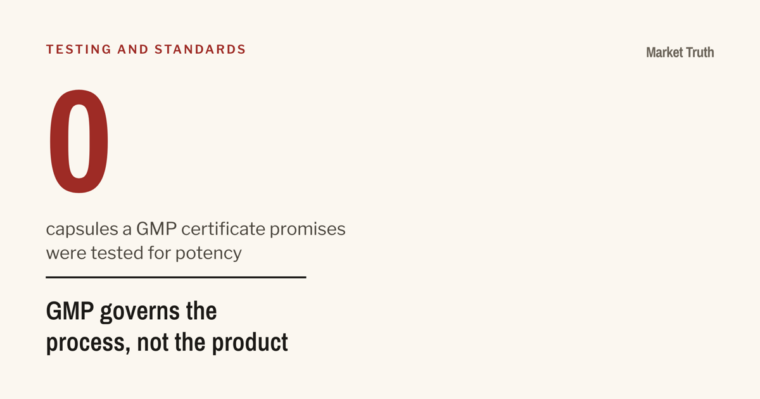
GMP is a claim about a process, not a claim about the capsule. The federal rule asks whether a manufacturer wrote procedures, followed them and documented the result. It does not ask whether the finished product matches the label. A plant can be fully compliant and still ship an underdosed capsule. "GMP certified" on a bottle usually names no auditor at all.
What does GMP certified mean on a supplement bottle?
It means the manufacturer says its facility follows good manufacturing practices. The federal rule behind the phrase is 21 CFR Part 111, titled “Current Good Manufacturing Practice in Manufacturing, Packaging, Labeling, or Holding Operations for Dietary Supplements”. Compliance with it is mandatory, not optional, so the claim describes a legal baseline rather than an achievement.
Part 111 runs to sixteen subparts covering personnel, physical plant, equipment, production and process controls, laboratory operations, packaging and labeling, holding and distribution, returned products, complaints and recordkeeping. Read it and the structure is unmistakable: it is a documentation regime. The controlling questions are whether you established a specification, whether you determined that it was met, and whether you wrote it down.
That is a real and useful standard. It is also not what most buyers think they are reading. The word “certified” implies an outside body issued something. In most cases on a supplement label, nobody did.
Who actually issues a GMP certificate for a supplement?
Not the FDA. Part 111 contains no provision for the agency to issue a certificate, a registration or a seal of compliance. The FDA enforces the rule by inspecting facilities and acting after the fact. The only certificates named anywhere in Part 111 are a supplier’s certificate of analysis and a calibration reference standard’s certification of accuracy.
Certificates that do exist come from private auditors and trade bodies, which are the organisations that operate third-party GMP audit schemes. Those audits can be rigorous. The problem is that the label almost never names the auditor, the standard audited against, or the date of the audit, so the reader cannot distinguish a genuine third-party audit from a self-declaration.
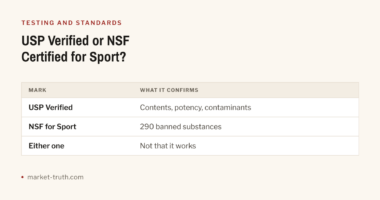
That is the test worth applying. A GMP claim is only checkable if the auditor is named. Compare that with programs that publish per-product listings: USP audits the plant, tests samples and retests products off the shelf, and NSF Certified for Sport requires the facility to be GMP-certified and audited annually or bi-annually on top of testing the product for 290 banned substances.
Does 21 CFR Part 111 require testing every batch for potency?
No, and this is the gap the marketing depends on. Under 21 CFR 111.75(c), a manufacturer must verify that finished batches meet product specifications “for a subset of finished dietary supplement batches that you identify through a sound statistical sampling plan (or for every finished batch)”. The subset is the manufacturer’s choice.
The rule narrows further. Section 111.75(c)(1) requires the firm to select one or more established specifications to test, not all of them, and 111.75(d)(1) lets the firm exempt a product specification from verification entirely where it documents that no scientifically valid finished-product test exists. Meanwhile 21 CFR 111.70 requires that the manufacturer establish its own specifications for identity, purity, strength and composition.
Put those three provisions together and the picture is clear. The firm writes the specification, chooses which specifications to test, chooses how many batches to test, and can document its way out of testing some of them. Compliance means the firm met its own targets. It does not independently mean the capsule contains the labeled dose.
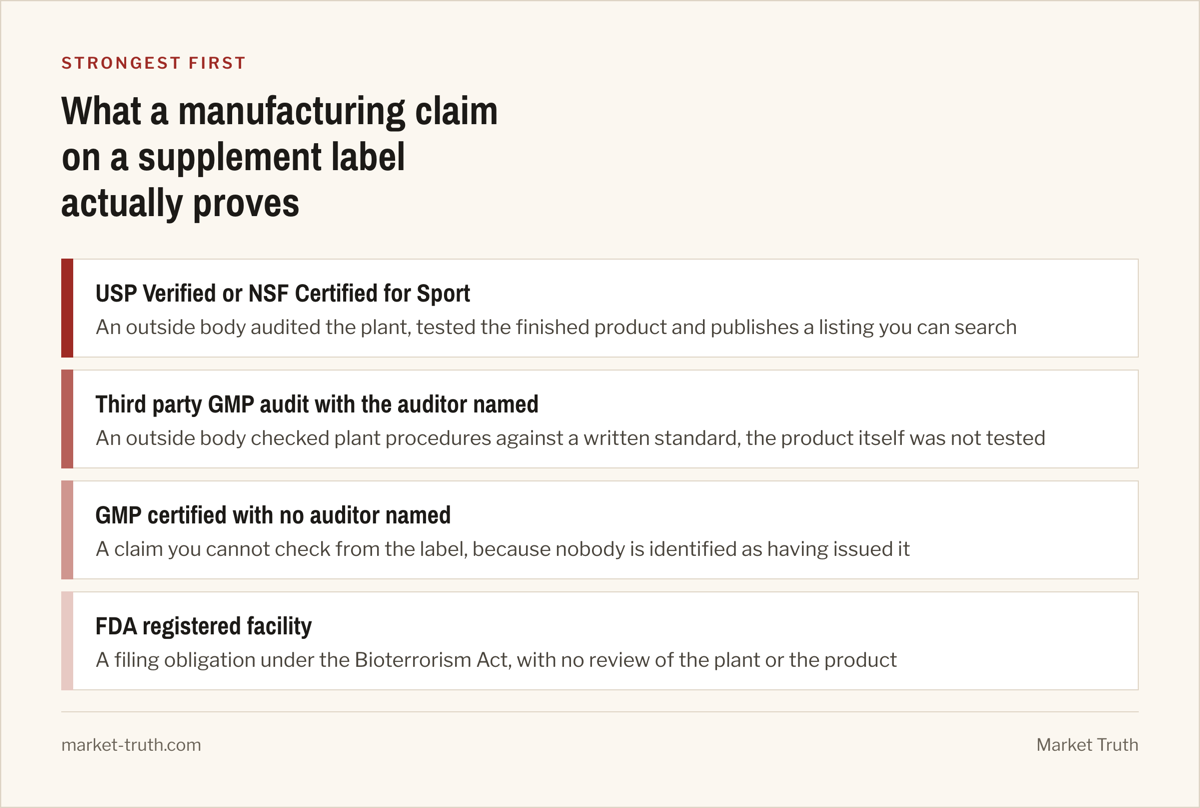
| Claim on the bottle | What was examined | What was not examined |
|---|---|---|
| GMP certified, auditor not named | Unknown. Possibly nothing beyond a self-declaration | The finished product, and whether the audit happened at all |
| Third party GMP audit, auditor named | Plant procedures and records against a written standard | The potency of the capsule you bought |
| FDA registered facility | A registration filing was submitted | The plant, the process and the product |
| USP Verified or NSF Certified for Sport | Facility audit plus laboratory testing of that finished product | Whether the ingredient works at the labeled dose |
Does a GMP claim cover the ingredient supplier too?
Partly, and the detail is worth knowing because most quality failures start upstream. Under 21 CFR 111.75(a)(1)(i), a manufacturer must conduct at least one appropriate test or examination to verify the identity of any component that is a dietary ingredient, unless it petitions the FDA for an exemption. Identity is the one thing that cannot be delegated by default.
Everything else about a component can be delegated. Section 111.75(a)(2) lets a manufacturer either run its own tests or rely on a certificate of analysis from the supplier. Relying on a supplier COA carries five written conditions: the firm must first qualify the supplier by confirming the supplier’s test results, the COA must describe the test methods, their limits and the actual results, the firm must document how it qualified the supplier, it must periodically re-confirm the COA, and quality control personnel must review and approve the qualification basis.
So a compliant firm may never independently test the potency of an incoming ingredient. It tests identity, then trusts a qualified supplier’s paperwork. That is precisely why an independent programme that tests the finished product, compared in USP Verified versus NSF Certified for Sport, is worth more than the supplier paperwork sitting behind it.
What happens when a batch fails to meet its specification?
Quality control personnel run a material review and make a disposition decision. Under 21 CFR 111.113(b)(2), when a specification established under 111.70 is not met, quality control personnel must reject the component, dietary supplement, package or label, unless those same personnel approve a treatment, an in-process adjustment or reprocessing as permitted by 111.77.
That “unless” is the whole system in one word. Rejection is the default, but the firm’s own quality control staff hold the authority to approve reprocessing instead. Section 111.77 permits that only where the approved treatment will ensure the quality of the finished dietary supplement, and no finished batch may be released for distribution unless it complies with 111.123.
The trail is at least preserved. Firms must hold reserve samples of each distributed lot under 111.83, must investigate any product complaint suggesting a specification failure under 111.560, must keep records for one year past the shelf life date or two years beyond distribution of the last batch under 111.605, and must make those records available to the FDA for inspection and copying under 111.610. Enforcement is real. It is simply post-market.
Is GMP certified stronger than FDA registered facility?
Yes, comfortably, though the bar it clears is low. Facilities that manufacture, process, pack or hold dietary supplements for US consumption must register with the FDA under the Public Health Security and Bioterrorism Preparedness and Response Act of 2002 before beginning operations. Registration is a filing obligation. Nobody reviews anything to grant it.
The FDA says so directly. The agency states that mere registration of an establishment or listing of a drug or device does not denote approval of the establishment, the drug or the device, nor does it mean a product may be legally marketed. A GMP claim at least asserts that a written standard exists and was followed. A registration claim asserts only that a form was filed.
Both sit downstream of the same structural fact. Under DSHEA, the FDA does not review supplements before they reach the market, and manufacturers are responsible for evaluating their own safety and labeling. If you want the full picture of what these two phrases each establish, we compared them in detail in FDA registered versus FDA approved.
What does a GMP claim not tell you about the capsule in your hand?
It tells you nothing about potency, nothing about whether the dose matches what was studied, and nothing about efficacy. NIH’s Office of Dietary Supplements states that quality seals from third-party testers do not guarantee that a product is safe or effective, and a GMP claim sits below those seals, not above them.
There is a legal floor underneath all of it. Under 21 U.S.C. 343(s)(2)(E), a supplement not covered by a compendial specification is misbranded if it fails to have the identity and strength it is represented to have, or fails to meet the quality, purity or compositional specifications it is represented to meet. That is enforcement after the fact, not assurance before purchase.
My judgement: an unattributed “GMP certified” badge is the claim I discount most heavily on a supplement label, more heavily than a bare “FDA registered facility”. “FDA registered” is at least literally true and points at a real filing. “GMP certified” with no auditor named borrows the vocabulary of independent audit without accepting any of its obligations. For a claim you can actually check, see our guide to third-party testing along with how we research these claims. Any decision to start or stop a supplement for a health condition should be made with a licensed clinician.
Questions readers ask
Does the FDA inspect supplement manufacturing facilities?
Yes. The FDA enforces 21 CFR Part 111 through facility inspections and post-market action rather than pre-market clearance. Section 111.610 requires firms to make all required records available to the FDA for inspection and copying on request.
Is cGMP the same as GMP on a label?
In practice yes. The federal rule uses current good manufacturing practice, and labels shorten it to GMP. Neither abbreviation tells you who audited the facility or against which written standard.
Do GMP rules apply to supplements imported into the US?
Part 111 applies to anyone who manufactures, packages, labels or holds a dietary supplement for US distribution, including foreign facilities. Enforcement reach and inspection frequency abroad are a separate practical question.
Can a GMP compliant product still be recalled?
Yes. Compliance with process controls does not prevent contamination, mislabeling or an adulterated ingredient reaching the market. Part 111 anticipates this, which is why it requires reserve samples, complaint investigations and returned-product reviews.
Sources
- 21 CFR Part 111, Current Good Manufacturing Practice for Dietary Supplements
- FDA, Dietary Supplements
- FDA, Is It Really FDA Approved?
- 21 U.S.C. 343, Misbranded food (dietary supplements, subsection s)
- NIH Office of Dietary Supplements, Dietary Supplements: What You Need to Know
- U.S. Pharmacopeia, USP Verified Mark
- NSF, Certified for Sport: What Our Mark Means
Primary sources last checked September 5, 2026.

About Erin Delaney
Erin Delaney is a health science journalist who has spent nine years reading the documents behind health product marketing. She covers dietary supplements, wellness devices and the advertising rules that govern them, working from FDA and FTC filings, NIH Office of Dietary Supplements fact sheets, USP and NSF standards and the primary research literature rather than press releases or vendor claims. Her interest started with one question that nobody on a product page ever answers: if the bottle says clinically proven, who actually checked, and against what? She is not a physician and does not give medical advice. Her job is to show you what the evidence says, and to be equally clear about where it runs out.
Related checks
-
How to verify a USP Verified mark on a supplement
USP Verified is the rare supplement seal you can check against a published list, and the phrase "USP grade" deliberately borrows its authority without earning it.
-
USP Verified or NSF Certified for Sport: which mark is worth more?
USP Verified and NSF Certified for Sport answer different questions, and picking the right seal depends entirely on whether your risk is label accuracy or a…