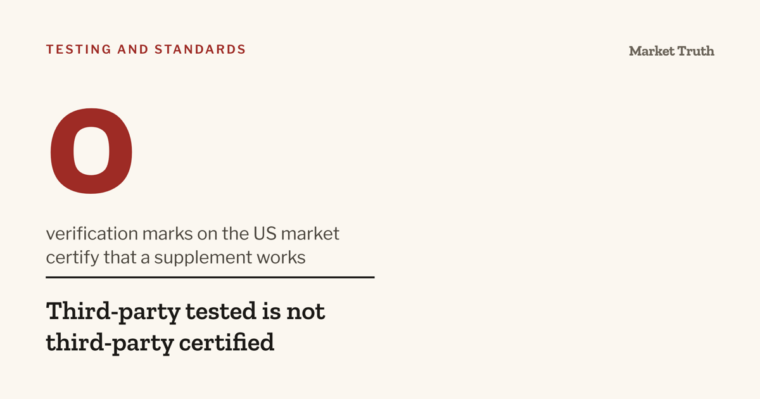
"Third-party tested" is a marketing phrase with no legal definition. The brand chooses the laboratory, chooses which batch gets sent, and decides whether the result is ever published. "Third-party certified" is a different thing: USP and NSF audit the facility, test against a published standard, and retest product bought off the shelf. Neither mark tells you the supplement works.
What does “third-party tested” mean on a supplement label?
It means the brand paid an outside laboratory to test something. It does not say which lab, which batch, which contaminants, or what the result was. The brand selects the sample, receives the report privately, and prints the phrase regardless. No agency defines the term and no one audits its use.
That is the whole mechanism, and it is why the phrase is so common. A brand can send one favorable batch to one laboratory once, in the first year of production, and keep the words on the panel for as long as the product sells. Nothing obliges it to test the batch you bought.
Compare that to how the FDA describes its own role. Under the Dietary Supplement Health and Education Act of 1994, the FDA states it has no authority to approve dietary supplements before they are marketed, and manufacturers themselves are responsible for evaluating safety and labeling. “Third-party tested” fills the vacuum that leaves. It sounds like oversight. It is a purchase order.
The useful question is never whether a brand tested. It is whether you can see the result, and whether the result matches the bottle in your hand.
Is “third-party tested” a regulated term?
No. There is no federal definition, no filing, no register of qualifying laboratories, and no penalty for using the phrase loosely. Nothing in 21 CFR requires a brand to name the lab or publish the data. Compare that with the label language the FDA does define down to the typeface.
The contrast is instructive. A supplement carrying a structure/function claim must display an exact disclaimer set out at 21 CFR 101.93(c): “This statement has not been evaluated by the Food and Drug Administration. This product is not intended to diagnose, treat, cure, or prevent any disease.” The regulation specifies boldface type no smaller than one-sixteenth of an inch, placement adjacent to the claim, and a box where it is not adjacent.
So the government writes the font size for the sentence that limits a claim, and writes nothing at all for the phrase that sells one. There is a second asymmetry worth naming. A firm making a structure/function claim must hold substantiation that the claim is truthful and not misleading, but that substantiation is never filed with or reviewed by the FDA. It sits in a drawer. A testing claim is weaker still, because no regulation asks the firm to hold anything at all.
Certification programs are the opposite case: USP and NSF publish their criteria, name their standards, and can withdraw a mark. If you want the fuller picture of which body governs which claim, see who regulates supplement claims.
What is the difference between tested and certified?
Testing is an event. Certification is a program. A test is one sample, one day, chosen by the seller. A certification involves a published standard, a facility audit, ongoing surveillance, and a mark that can be revoked. Four rungs separate the weakest evidence from the strongest, and most labels sit on rung three.
The four-rung ladder of supplement testing:
- Self-tested. The brand’s own laboratory tests the brand’s own product. No independent party is involved at any point. Worth nothing to a shopper.
- Lab-tested. Testing happened somewhere. The phrase does not even promise the lab was independent. Worth nothing to a shopper.
- Third-party tested. An outside laboratory ran an assay on a sample the brand selected and sent. Worth something only if a lot-matched certificate of analysis is published.
- Third-party certified. An independent body audits the manufacturing facility, tests against its own published standard, and retests product it buys off the shelf. Worth the most, and the only rung with continuing consequences.
The gap between rung three and rung four is deliberate, and it is commercial. Certification means an audit, a published standard, and a mark that can be withdrawn. A single laboratory invoice carries none of that risk and buys the same four words in the shopper’s eye. Brands that could seek certification and choose not to are telling you something.
Third-party tested means a brand once paid an outside lab to look at a sample it chose; third-party certified means an independent body with a published standard audits the facility, tests to that standard, and keeps retesting product bought at retail.
What does the USP Verified Mark actually certify?
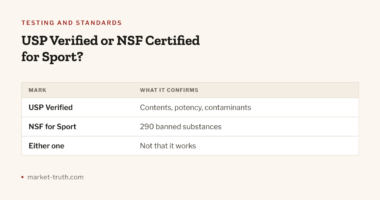
Four things. According to the U.S. Pharmacopeia, the mark indicates the product contains the ingredients on the label in the declared potency and amounts, does not contain harmful levels of specified contaminants, will break down and release within a specified time, and was made according to FDA current Good Manufacturing Practices.
The mechanism behind those four attestations matters more than the list. USP verification includes a manufacturing facility audit, review of manufacturing and quality-control documentation, laboratory testing of samples, and off-the-shelf retesting of verified products. That last element is the one no “third-party tested” claim has. USP buys the product the way you do, and tests that.
The audit runs against USP General Chapter 2750 and 21 CFR Part 111, the federal current good manufacturing practice rule for dietary supplements. USP reports the mark has appeared on more than 700 million labels and packages since the program began. Note what is absent from all four attestations: any statement about whether the ingredient does anything. Potency, purity, dissolution, process. Not benefit.
What does NSF Certified for Sport certify?
It certifies the absence of banned substances first, and label accuracy second. NSF states that Certified for Sport products are verified not to contain any of 290 substances banned by major athletic organizations, that contents match the label, that there are no unsafe levels of contaminants, and that the facility is GMP-certified and audited annually or bi-annually.
The standards behind it are NSF/ANSI 173 for supplements and NSF 229 for functional foods. The program exists because athletes face strict liability: a contaminated pre-workout ends a career regardless of intent. NSF reports that Certified for Sport is the only independent third-party certification program recognized by the U.S. Anti-Doping Agency, Major League Baseball, the National Hockey League and the Canadian Football League.
That recognition by four separate bodies is the strongest external validation any supplement mark carries. It is also narrow. The program answers “will this cost me my license”, not “will this help me”. For a side-by-side of the two major programs, read USP Verified versus NSF Certified.
Do any of these marks mean the supplement works?
No. Not one of them. Quality seals from third-party testers, the NIH Office of Dietary Supplements states, “do not guarantee that a product is safe or effective”. ODS says this explicitly of ConsumerLab.com, NSF International and U.S. Pharmacopeia by name. Verification is about what is in the capsule, never about what the capsule does.
This is the single most important sentence on this page, so read the failure mode plainly. A USP Verified fish oil contains the stated dose of EPA and DHA, free of harmful contaminant levels, made in an audited facility. If that dose has no effect on the outcome you bought it for, the mark is still entirely valid. Certification confirms the delivery, not the destination.
The same ODS fact sheet notes the FDA does not determine whether dietary supplements are effective before they are marketed. So efficacy is unverified at both ends: not by the regulator before sale, and not by the certifier after. Whether an ingredient works is a separate question with a separate evidence base, covered in how to tell if a supplement works. If a supplement decision involves a medication or a diagnosed condition, that is a conversation for a licensed clinician, not a label.
What is a certificate of analysis, and can I trust one?
A certificate of analysis, or COA, is the laboratory’s report on one specific batch. A useful one shows four things: the lot number, the laboratory’s name and accreditation, the test date, and exactly which assays were run. A COA missing any of those is not evidence, and a brand-supplied COA with no lot number is evidence of nothing.
Start with the lot number. It has to match the code stamped on the bottle you are holding. A report on a lot that is not the lot in front of you tells you nothing about the capsules you will swallow. Brands that post a single undated PDF and leave it up for years are relying on nobody checking, and almost nobody checks.
Then read what was actually assayed. A COA that reports identity and potency but never tested for heavy metals, microbes or solvent residues has not cleared the product of those things. It has stayed silent about them. Silence reads as a pass to most shoppers, which is exactly why the narrower testing panel gets ordered. The mechanics of reading one line by line are set out in our guide to the supplement certificate of analysis.
What does “GMP certified” mean on a bottle?
It means a facility’s processes were assessed against a good manufacturing practice standard. GMP governs process, not product. A facility can hold a valid GMP certificate and still ship an underdosed capsule, because the standard asks whether procedures were followed and documented, not whether this bottle contains what the label says.
Most bottles do not name the auditor, which makes the claim unverifiable on its face. USP treats current Good Manufacturing Practices as one input among four, auditing against 21 CFR Part 111 alongside its own testing. On its own, detached from any product testing, the phrase is a floor rather than a signal.
“Made in an FDA registered facility” is weaker still, and it is the claim I would discount to zero. Facilities that manufacture, process, pack or hold supplements for US consumption must register with the FDA under the Bioterrorism Preparedness and Response Act of 2002. That is a filing obligation. As the FDA puts it, “mere registration of an establishment… does not denote approval of the establishment, the drug or device”.
What should I actually look for?
Rank the marks by what stands behind them. USP Verified and NSF Certified for Sport sit at the top because both audit the facility and both keep testing after the certificate is issued. ConsumerLab Approved sits just below. Everything else on a label is worth less than the ink.
| Mark or phrase | Who verifies it | What it confirms | What it does not confirm |
|---|---|---|---|
| USP Verified | U.S. Pharmacopeia | Ingredients and potency as labeled, contaminants below harmful levels, dissolution within a set time, cGMP manufacture, plus a facility audit and off-the-shelf retesting | That the product has any effect |
| NSF Certified for Sport | NSF | None of 290 banned substances, contents match the label, no unsafe contaminant levels, GMP facility audited annually or bi-annually | That the product has any effect |
| ConsumerLab Approved | ConsumerLab.com | Identity, strength, purity and disintegration where testable; CL Seal products retested every twelve months from a randomly purchased open-market sample | Efficacy, and the state of the manufacturing facility |
| “Third-party tested” | Nobody. The brand picks the lab and the batch | Nothing verifiable unless a lot-matched COA is published | Identity, potency, purity, or that your batch was tested at all |
| “GMP certified” | Varies, and most labels do not name the auditor | That process controls were assessed against a standard | That this bottle contains the labeled dose |
| “Made in an FDA registered facility” | Nobody. Registration is a filing | That a facility filed a registration with FDA | Anything about quality. FDA: registration “does not denote approval” |
ConsumerLab.com tests, where possible, for identity, strength, purity and disintegration, and its CL Seal products must be retested every twelve months from a randomly purchased open-market sample. That open-market sampling is the same discipline USP applies, which is why it belongs in the top group rather than with the label phrases.
Two questions separate a real signal from a printed one. Does an independent body with a published standard stand behind the mark, and does anyone test product bought at retail rather than sent by the brand? USP, NSF and ConsumerLab all answer yes to both. No unqualified label phrase answers yes to either.
Here is the judgement call. I would treat “third-party tested” with no published lot-matched COA as equivalent to no testing claim at all, and “made in an FDA registered facility” as a claim that actively misleads. A certified mark plus a matching COA is the only combination that survives scrutiny. Our full method is set out in how we research.
Questions readers ask
Does the FDA test supplements before they go on sale?
No. FDA states it has no authority to approve dietary supplements before marketing, and generally does not approve supplement claims or labeling before use. Manufacturers themselves are responsible for evaluating safety and labeling. FDA acts after a product reaches the market.
Who polices supplement advertising rather than labels?
FDA is generally responsible for supplement safety, quality and labeling, while the FTC is generally responsible for advertising. Both agencies can bring enforcement actions. A claim can therefore be an FDA labeling problem and an FTC advertising problem at once.
Should a certified supplement be retested after I buy it?
That is what the certifiers do themselves. USP performs off-the-shelf retesting of verified products, and ConsumerLab requires CL Seal products to be retested every twelve months from a randomly purchased open-market sample. A one-off brand test has no such step.
How many US adults take dietary supplements?
NHANES 2017-2018 data from CDC/NCHS shows 57.6% of US adults aged 20 and over used a dietary supplement in the past 30 days. Use was higher among women at 63.8% than men at 50.8%, and highest among women aged 60 and over at 80.2%.
Sources
- FDA, Questions and Answers on Dietary Supplements
- 21 CFR 101.93, Certain types of statements for dietary supplements
- U.S. Pharmacopeia, USP Verified Mark
- NSF, Certified for Sport: What Our Mark Means
- NIH Office of Dietary Supplements, Dietary Supplements: What You Need to Know
- ConsumerLab.com, About
- FDA Consumer Update, Is It Really "FDA Approved"?
- CDC/NCHS Data Brief No. 399, Dietary Supplement Use Among Adults
Primary sources last checked September 5, 2026.
Every check in this guide
-
USP Verified or NSF Certified for Sport: which mark is worth more?
USP Verified and NSF Certified for Sport answer different questions, and picking the right seal depends entirely on whether your risk is label accuracy or a…