Neither is better in general, because they answer different questions. USP Verified audits the product and the factory and retests off-the-shelf stock, which makes it the stronger general-purpose mark. NSF Certified for Sport screens for 290 banned substances and is the only programme recognised by USADA, MLB, the NHL and the CFL. Neither seal certifies that the supplement works.
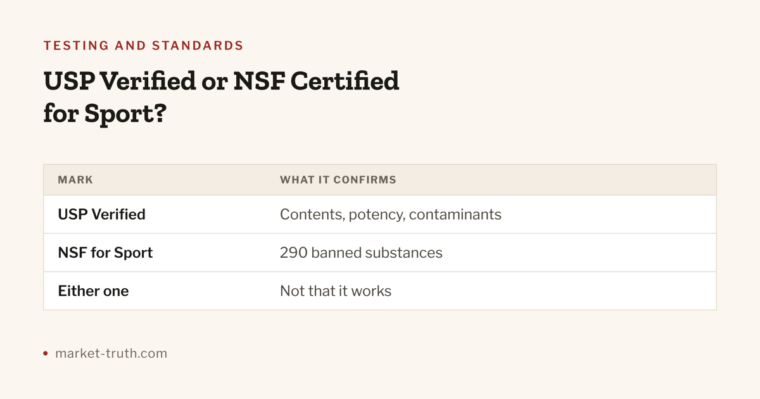
What is the difference between USP Verified and NSF Certified for Sport?
USP Verified is a product-and-facility programme built around label accuracy, contaminants, dissolution and manufacturing practice. NSF Certified for Sport is built around banned-substance screening for athletes subject to drug testing, layered on top of label and contaminant checks. The overlap is real. The design intent is not the same.
USP is a pharmacopeial standards body. Its verification work is anchored to its own general chapter and to federal manufacturing regulation. NSF is a certification body whose sport programme exists because contaminated supplements end athletic careers.
That difference in purpose explains almost every practical distinction between the two marks: what gets tested, how often, who audits the plant, and what the seal actually promises the person holding the bottle. Read the seal as an answer to a question, and first work out which question you are asking. My overview of what third-party tested actually means sets out the wider landscape.
What does the USP Verified Mark actually test?
Four things. According to the United States Pharmacopeia, the mark indicates the product contains the ingredients listed on the label in the declared potency and amounts, does not contain harmful levels of specified contaminants, will break down and release within a specified time, and was made according to FDA current Good Manufacturing Practices.
The dissolution criterion is the one competitors do not match as a headline. A capsule that contains the right amount of an ingredient but does not disintegrate inside the specified window is a capsule you excreted intact. USP tests for that explicitly.
The programme’s mechanics are what give the mark its weight. USP states that verification includes a manufacturing facility audit, review of manufacturing and quality control documentation, laboratory testing of samples, and off-the-shelf retesting of verified products. The audit runs against USP General Chapter 2750 and 21 CFR Part 111. USP reports the mark has appeared on more than 700 million labels and packages since the programme began.
What does NSF Certified for Sport actually test?
Banned substances first, then the ordinary quality questions. NSF verifies that products do not contain any of 290 substances banned by major athletic organisations, that the contents match the label, that there are no unsafe levels of contaminants, and that the facility is GMP-certified and audited by NSF.
The banned-substance screen is the reason the programme exists and the reason it is expensive. Contamination with a prohibited stimulant or steroid metabolite is usually accidental, arising from shared equipment or a tainted raw ingredient, and it is invisible on any label. No amount of reading the Supplement Facts panel detects it.
The audit cadence is stated plainly by NSF: facilities are GMP certified and audited annually or bi-annually based on grade. NSF also developed NSF/ANSI 173 for dietary supplements and NSF 229 for functional foods, the underlying standards that Certified for Sport sits on top of. A product can carry NSF certification to those standards without carrying the sport mark, so check which mark you are looking at.
Which programme do drug-tested athletes need?
Certified for Sport, and nothing else will do. NSF states it is the only independent third-party certification programme recognised by the United States Anti-Doping Agency, Major League Baseball, the National Hockey League and the Canadian Football League. Recognition by the governing body is the whole point.
This is not a quality judgement about USP. A USP Verified product may well be free of banned substances. It has simply not been screened against the 290-substance list, and no anti-doping authority will accept it as evidence that it was.
NSF also reports that Certified for Sport is recommended by the NFL, NBA, PGA, LPGA and others, and quotes MLB stating that clubs are permitted to provide and recommend only Certified for Sport products. For anyone whose livelihood depends on a negative test, this is the only column in the table that matters.
Where does ConsumerLab fit?
It is the only one of the three that buys products off the open market rather than testing what a brand submits. ConsumerLab tests, where possible, for identity, strength, purity and disintegration, and products must meet those criteria to be listed as Approved. That sampling method is a structural advantage.
The retest rule is the second advantage. ConsumerLab states that CL Seal products must be retested every twelve months from a randomly purchased open-market sample. A brand cannot pass by preparing a golden batch, because the sample is whatever a shopper would have bought.
The limitation is coverage and access. ConsumerLab reports testing more than 7,000 products from over 1,000 brands since it was founded, and much of its reporting sits behind a subscription. It is an independent tester and a publisher, not a facility auditor. It will not tell you the plant was inspected.
Does any of these seals mean the supplement works?
No. Not one of them. A seal certifies that the contents match the label and that contaminants are within limits. It makes no statement whatsoever about whether the ingredient produces the benefit printed on the front of the pack.
The NIH Office of Dietary Supplements states that quality seals from third-party testers do not guarantee that a product is safe or effective, naming ConsumerLab.com, NSF International and U.S. Pharmacopeia specifically. That sentence is worth more than any marketing page about any of the three.
ODS also states that the FDA does not determine whether dietary supplements are effective before they are marketed. So efficacy is unverified at both ends: the regulator does not check it, and the certifier does not claim to. Efficacy claims live in an entirely separate regime, which I cover in what “clinically proven” means on a supplement label.
| Programme | Core verification | Post-launch retesting | Facility audit |
|---|---|---|---|
| USP Verified | Label accuracy, potency, contaminants, dissolution, cGMP | Off-the-shelf retesting of verified products | Yes, against USP General Chapter 2750 and 21 CFR Part 111 |
| NSF Certified for Sport | 290 banned substances, label match, contaminant limits | Ongoing certification, lot-level testing | Yes, GMP certified and audited annually or bi-annually |
| ConsumerLab Approved | Identity, strength, purity, disintegration | Every twelve months, randomly purchased open-market sample | No |
Which one should you look for?
It depends on which risk you are managing, and the honest answer differs for three readers. There is no universal winner, but there is a clear default. Here is what I would choose in each case, and why.
- The general shopper. USP Verified. It is the only one of the three that combines a facility audit, laboratory testing, a dissolution requirement and off-the-shelf retesting in a single programme. That combination covers the widest range of ways a supplement fails.
- The drug-tested athlete. NSF Certified for Sport, without exception. Recognition by USADA, MLB, the NHL and the CFL is not a marketing point. It is the only credential those bodies accept, and the consequences of getting it wrong are career-ending.
- The reader worried about contamination. ConsumerLab, used alongside a seal. The annual retest from a randomly purchased open-market sample is the single hardest test to game, because the brand does not choose the bottle.
The judgement I will defend: USP Verified is the better mark for most people, and the reason is off-the-shelf retesting rather than the initial audit. Any programme can certify a batch a manufacturer knew was being watched. Retesting stock pulled from the shelf tests the thing that actually matters, which is whether the manufacturer holds the standard when nobody is looking. That is also why the missing element on a certificate matters so much, which I set out in how to tell whether a certificate of analysis is real.
None of this substitutes for clinical advice. If you are choosing a supplement for a diagnosed condition or taking prescription medication, raise it with a licensed clinician. The standards behind these comparisons are published in full.
Questions readers ask
Can a product carry both the USP Verified Mark and NSF Certified for Sport?
Yes. The two programmes are independent of each other and a manufacturer can enrol in both. Each certification is paid for and maintained separately, so carrying one mark tells you nothing about whether the other was sought.
Is an NSF mark without the words "Certified for Sport" the same thing?
No. NSF certifies dietary supplements to NSF/ANSI 173 and functional foods to NSF 229 without the sport programme. Certified for Sport adds the 290-substance banned list screen. Athletes need the sport mark specifically.
Does a third-party seal mean the FDA reviewed the product?
No. Under DSHEA the FDA does not approve dietary supplements before marketing, and third-party certification is a private, voluntary programme. The seal is a commercial credential, not a regulatory one, and carries no federal status.
How much of the supplement market carries any of these seals?
No agency publishes that figure. USP reports its mark has appeared on more than 700 million labels and packages since the programme began, and ConsumerLab reports testing over 7,000 products, but neither maps to market share.
Does ConsumerLab audit manufacturing facilities?
No. ConsumerLab tests purchased products for identity, strength, purity and disintegration. It does not inspect plants or review manufacturing documentation, which is the main structural difference between it and the USP and NSF programmes.
Sources
- U.S. Pharmacopeia, USP Verified Mark
- NSF, Certified for Sport: What Our Mark Means
- ConsumerLab.com, About
- NIH Office of Dietary Supplements, Dietary Supplements: What You Need to Know
- 21 CFR Part 111, Current Good Manufacturing Practice for Dietary Supplements
- FDA, Questions and Answers on Dietary Supplements
Primary sources last checked September 5, 2026.

About Erin Delaney
Erin Delaney is a health science journalist who has spent nine years reading the documents behind health product marketing. She covers dietary supplements, wellness devices and the advertising rules that govern them, working from FDA and FTC filings, NIH Office of Dietary Supplements fact sheets, USP and NSF standards and the primary research literature rather than press releases or vendor claims. Her interest started with one question that nobody on a product page ever answers: if the bottle says clinically proven, who actually checked, and against what? She is not a physician and does not give medical advice. Her job is to show you what the evidence says, and to be equally clear about where it runs out.