You cannot tell from a supplement label whether the product works, because no US agency reviews efficacy before sale. What you can do is run six checks yourself: compare the capsule dose against the studied dose, match the exact ingredient form, find out who funded the study, open up any proprietary blend, check the outcome measured, and read the disclaimer. Two of those catch most bad products.
The method, in the order that catches the most products fastest:
- Find the studied dose, then divide. If one serving delivers less than half of what the trial used, stop there.
- Match the exact form. Extract or whole herb, standardisation percentage, branded or generic. A different form is a different ingredient.
- Open the proprietary blend. If the amounts are hidden, assume the last-listed ingredient is a trace and price the product accordingly.
- Check who paid. A single trial funded by the company selling the ingredient is the weakest tier of evidence that exists.
- Compare the outcome measured to the outcome advertised. A laboratory task is not the benefit on the front of the box.
- Read the disclaimer. It appears because a structure/function claim was made, which tells you the claim was never reviewed.
Why can’t you tell from the label whether a supplement works?
Because nothing on the label has been checked for efficacy by anyone. Under the Dietary Supplement Health and Education Act of 1994, the FDA does not have authority to approve dietary supplements before they are marketed, and generally does not approve supplement claims or labeling before use. The label is the manufacturer’s own assertion.
The FDA states plainly that manufacturers and distributors are responsible for evaluating the safety and labeling of their own products before marketing, and that the agency’s authority is to act after the product reaches the market. NIH’s Office of Dietary Supplements puts the efficacy half in one sentence: the FDA “does not determine whether dietary supplements are effective before they are marketed.”
The same holds for the phrase “FDA registered facility”. The FDA is explicit that “mere registration of an establishment” does not denote approval of the establishment or the product, nor that a product may legally be marketed.
There is a substantiation requirement, and it is weaker than it sounds. A firm making a structure/function claim must have substantiation that the claim is truthful and not misleading. That substantiation is never filed with the FDA and never reviewed by it. Nobody outside the company sees the file.
The FDA itself notes that because it does not approve supplements before marketing, the agency “often does not know when new products come on the market” and cannot keep a complete list of what is being sold. If you want the full division of labour between the agencies, that is covered in who regulates supplement claims.
Does the product contain the dose that was actually studied?
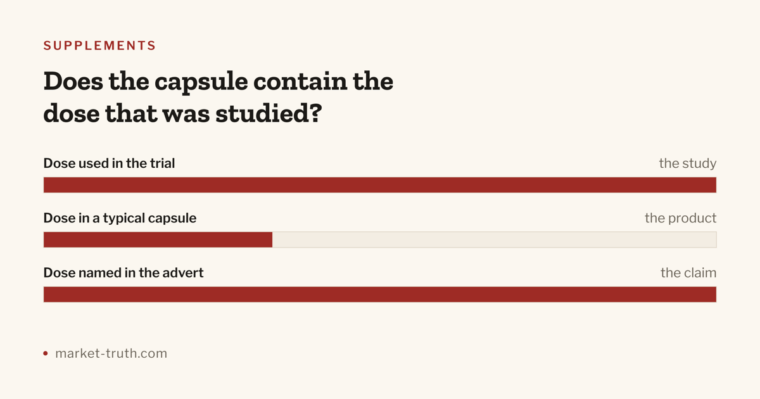
This is the single most useful check, and it fails more products than every other check combined. A study uses one specific amount per day. The capsule frequently contains a fraction of it. The label cites the study anyway, because citing a study is not regulated the way stating a dose is.
Run the arithmetic in three steps. First, find the daily dose used in the trial the marketing points to, including how many times a day it was taken. Second, read the Supplement Facts panel for the amount per serving and the serving size. Third, divide.
Take a trial that used 600 mg twice daily, so 1,200 mg per day. The bottle declares 150 mg per capsule, serving size one capsule. That is 150 divided by 1,200, or 12.5% of the studied intake. Reaching the trial dose would take eight capsules a day, which turns a 60-capsule bottle into a seven-day supply.
A product delivering under half the studied daily dose has no evidence behind it at that dose, regardless of which study the label cites. That is the check to run first, standing in the shop.
Was the studied ingredient the same as the ingredient in the bottle?
Often it is not. A trial that tested a standardised extract tells you nothing about ground whole herb. A trial on a branded, trademarked extract tells you about that extract’s specific manufacturing, not about a generic version of the same plant. Dose arithmetic is worthless if the ingredient itself does not match.
Three things have to line up: the plant part or source material, the extraction method, and the standardisation percentage. Standardisation is where labels get quietly misleading, because the percentage and the milligram figure interact and most shoppers only read one of them.
Here is the arithmetic. An extract standardised to 5% withanolides at 600 mg delivers 30 mg of withanolides. An extract standardised to 10% at 300 mg delivers 30 mg of withanolides. Identical active content. The first label shows a bigger number and reads as the stronger product.
Ingredient form also drives the marketing on entire product categories. Two worked examples on this site: magnesium L-threonate and the brain, and whether vitamin D3 needs K2.
Who paid for the study behind the claim?
Check the funding statement before you read the results. A single trial paid for by the company that sells the ingredient, run on that company’s branded material, is the weakest tier of evidence in this field. It is not worthless. It is one data point produced by a party with a direct financial interest in the outcome.
The funding and competing-interests statement sits at the end of almost every published paper. Read it for three things: who paid, whether any author is an employee, shareholder or patent holder, and whether the branded ingredient supplier provided the material.
The FTC’s Health Products Compliance Guidance sets the standard advertisers must meet: “competent and reliable scientific evidence”, which it defines as research “sufficient in quality and quantity based on standards generally accepted in the relevant scientific fields, when considered in light of the entire body of relevant and reliable scientific evidence.” Quantity is doing real work in that sentence. One trial is not a body of evidence.
The FTC also states that as a general matter, substantiation of health-related benefits needs to be randomised, controlled human clinical testing. Consumer testimonials do not fill the gap: under 16 CFR 255.2(a), “consumer endorsements themselves are not competent and reliable scientific evidence.”
What does a proprietary blend hide?
It hides every individual amount. A proprietary blend declares one total for the whole blend and lists the ingredients inside it in descending order by weight. You learn the ranking and the sum. You do not learn how much of anything you are getting, which is exactly the number the dose check needs.
The arithmetic that matters here is the maximum possible dose. Take a 500 mg blend listing six ingredients. Because they are ordered by weight, the last-listed ingredient can be no more than 500 divided by 6, or roughly 83 mg, and in practice will be far less. If the first ingredient is 400 mg of something cheap, the remaining five share 100 mg.
Apply that ceiling to the ingredient the marketing is actually about. If the headline botanical is listed fifth in a 500 mg blend, its maximum possible amount is a small double-digit figure, and the studied dose is frequently in the hundreds of milligrams.
A proprietary blend is not a formulation secret. It is a disclosure choice that makes the dose check impossible to run.
Was the outcome measured the outcome being advertised?
This is the check almost nobody runs. A study can be real, adequately sized, honestly reported, and still not support the sentence on the packaging, because it measured something narrower. The gap between the endpoint tested and the benefit advertised is where most legally interesting claims live.
The FTC gives the cleanest illustration. In Example 35 of its Health Products Compliance Guidance, a product advertised as “clinically proven to improve memory” is not substantiated by a study showing statistically significant gains only on working-memory laboratory tasks, because other types of memory were never tested. The study happened. The claim still overreaches it.
Translate that into a shopping check. Read the advertised benefit, then find what the trial actually measured. Look for the swap from a narrow laboratory measure to a broad life outcome: a reaction-time task sold as focus, a blood marker sold as immunity, a questionnaire score sold as energy.
The phrase “clinically proven” is not defined or approved by any US agency. Under FTC guidance, marketers must hold at least the level of support they claim to have. Imagery counts too: FTC Example 1 treats a brochure of lab coats, microscopes and journal pages as conveying an implied clinically proven claim on its own.
What does the disclaimer on the bottle tell you?
It tells you a structure/function claim was made, and that no agency evaluated it. The disclaimer is not decorative legal boilerplate. It is a required marker under 21 CFR 101.93, and its presence is a reliable signal that the product is making a benefit claim which was never reviewed. A genuine health claim works differently. “Adequate calcium throughout life may reduce the risk of osteoporosis” is an NLEA authorized health claim and does require FDA premarket review under the significant scientific agreement standard.
The exact text required for a single claim is: “This statement has not been evaluated by the Food and Drug Administration. This product is not intended to diagnose, treat, cure, or prevent any disease.” The plural version substitutes “These statements have not been evaluated”. Both are specified in 21 CFR 101.93(c).
The formatting is prescribed too. The disclaimer must appear in boldface type no smaller than one-sixteenth inch, adjacent to the claim or linked to it by a symbol, and boxed where it is not adjacent. A firm hiding it in five-point grey type is not complying.
One more timing detail worth knowing: the firm must notify the FDA no later than 30 days after it starts marketing the product, and certify it holds substantiation. Notification comes after sale, not before.
Does a quality seal mean a supplement works?
No. This trips up almost everyone. A third-party seal addresses what is in the bottle, not whether what is in the bottle does anything. NIH’s Office of Dietary Supplements states directly that quality seals from third-party testers “do not guarantee that a product is safe or effective”, naming ConsumerLab.com, NSF International and U.S. Pharmacopeia.
What the seals do cover is genuinely valuable, and worth knowing precisely. The USP Verified Mark indicates the product contains the listed ingredients in the declared potency and amounts, contains no harmful levels of specified contaminants, will break down and release within a specified time, and was made under FDA current Good Manufacturing Practices, audited against USP General Chapter 2750 and 21 CFR Part 111.
NSF Certified for Sport verifies that a product contains none of 290 substances banned by major athletic organisations, that contents match the label, and that the facility is GMP-certified and audited, under NSF/ANSI 173. It is the only such programme recognised by USADA, Major League Baseball, the National Hockey League and the Canadian Football League. Full breakdown: what third-party testing actually verifies.
What does this method actually get you?
It gets you out of the two failure modes that account for most wasted money: paying for a fraction of a studied dose, and paying for an ingredient form that was never studied. Those are checks one and two, and they are the two worth running first. Both can be done from the Supplement Facts panel and the study abstract, without a subscription and without expertise.
The other four are slower and catch less. Funding and outcome-matching both require pulling the actual paper, which most shoppers will not do standing in an aisle. The proprietary blend check is instant but only tells you that the dose check is impossible, which is itself a verdict.
| The check | What to look for | What a failure looks like | How hard to verify |
|---|---|---|---|
| Studied dose | Trial daily dose versus mg per serving on the Supplement Facts panel | Serving delivers under half the studied daily amount | Easy, if the study is named |
| Ingredient form | Extract versus whole herb, standardisation percentage, branded versus generic | Label cites a trial on a branded extract, bottle contains a generic one | Moderate |
| Proprietary blend | Blend total, position of the headline ingredient in the list | The advertised ingredient is listed last | Easy, and the answer is always the same |
| Study funding | Funding and competing-interests statement on the paper | Sole trial paid for by the ingredient supplier | Moderate, needs the paper itself |
| Outcome match | Endpoint measured versus benefit advertised | Laboratory task sold as a life outcome | Hard, needs the methods section |
| Disclaimer | 21 CFR 101.93 wording, boldface, adjacent or boxed | Present and buried in unreadable type | Easy |
Be clear about what the method cannot do. It cannot tell you a product works. It is a filter that removes products which cannot possibly work as sold, and it says nothing about whether an ingredient that passes all six checks will do anything for you specifically. It also cannot detect a well-dosed product built on an ingredient that simply has no good evidence behind it in the first place.
Anything affecting a diagnosed condition or a prescription belongs with a licensed clinician, not a label. Our full research method sets out how we source and check every claim on this site.
Questions readers ask
Does the FDA test supplements before they go on sale?
No. Under DSHEA, the FDA does not have authority to approve dietary supplements before marketing. The FDA states it often does not know when new products come on the market, and cannot keep a complete list of supplements sold in the US.
What is the difference between a structure/function claim and a health claim?
A structure/function claim such as calcium builds strong bones needs no FDA review and carries the 21 CFR 101.93 disclaimer. An NLEA authorized health claim requires FDA premarket review under the significant scientific agreement standard.
Does an FDA registered facility mean the supplement was checked?
No. The FDA states that mere registration of an establishment does not denote approval of the establishment or the product, nor that a product may be legally marketed. Facility registration is a filing obligation, not a quality review.
Is clinically proven a regulated phrase?
No US agency defines or approves it. FTC guidance requires that marketers of health-related products hold at least the level of support they claim, so the phrase obliges the seller to have clinical proof of that exact effect.
Who handles false supplement advertising, the FDA or the FTC?
The FTC is generally responsible for advertising, and the FDA for supplement safety, quality and labeling. Both can bring enforcement actions. FTC guidance treats packaging, websites, social media and influencer posts as advertising.
Sources
- FDA, Questions and Answers on Dietary Supplements
- FDA, Dietary Supplements
- NIH ODS, Dietary Supplements: What You Need to Know
- 21 CFR 101.93, Certain types of statements for dietary supplements
- FTC, Health Products Compliance Guidance
- FDA, Is It Really FDA Approved?
- U.S. Pharmacopeia, USP Verified Mark
- NSF, Certified for Sport: What Our Mark Means
Primary sources last checked September 5, 2026.

About Erin Delaney
Erin Delaney is a health science journalist who has spent nine years reading the documents behind health product marketing. She covers dietary supplements, wellness devices and the advertising rules that govern them, working from FDA and FTC filings, NIH Office of Dietary Supplements fact sheets, USP and NSF standards and the primary research literature rather than press releases or vendor claims. Her interest started with one question that nobody on a product page ever answers: if the bottle says clinically proven, who actually checked, and against what? She is not a physician and does not give medical advice. Her job is to show you what the evidence says, and to be equally clear about where it runs out.