Creatine gummies are a chemistry problem before they are a value problem. Creatine monohydrate degrades into creatinine in the presence of moisture and heat, and a gummy is a wet, heat-set product. Published stability work found 90 percent of the creatine in an aqueous supplement solution had degraded within 45 days at room temperature. No US agency checks the contents before sale. Powdered monohydrate is the boring, tested answer.
Do creatine gummies actually contain the creatine on the label?
Often less than the label states, and nobody verifies it before the product ships. When I last searched the PubMed record there was no published, peer-reviewed content analysis of creatine gummies specifically. What does exist is stability chemistry and adjacent label-versus-content testing, and both point the same direction: the declared figure on a gummy pack is a claim, not a measurement.
The relevant law is DSHEA. According to the FDA, the agency “does not have authority to approve dietary supplements before they are marketed,” and manufacturers alone are responsible for evaluating the safety and labeling of their products before sale (FDA, Questions and Answers on Dietary Supplements). The FDA acts after a product reaches the market, not before.
So the label number is unaudited by default. That is true of powder too. The difference is that a gummy adds a degradation pathway that a sealed tub of dry powder does not have.
Why does creatine break down in a gummy?
Creatine monohydrate converts to creatinine, an inert breakdown product, when it sits in water. The reaction speeds up with heat and with acidic conditions. A gummy is a pectin or gelatin matrix with residual water, made by heating a slurry, then stored at room temperature for months. Every one of those conditions favours conversion.
The clearest published figure comes from a stability study of creatine in solution, prepared from effervescent creatine powders and stored at 25 degrees Celsius and at 4 degrees Celsius. The authors reported that 90 percent creatine degradation was observed within 45 days at room temperature, and 80 percent under refrigeration over the same period (AAPS PharmSciTech, 2003).
That was a solution, not a confection, and the water activity in a gummy is lower. The mechanism is the same one, running slower. The honest statement is that nobody has published a shelf-life curve for creatine in a gummy matrix, and until somebody does, the buyer is carrying that risk.
Has anyone actually lab-tested creatine gummies?
Not in the peer-reviewed literature, as far as the published record shows. Brand-level results have circulated in consumer coverage, but the underlying test reports were not published as verifiable primary sources, so this page does not name brands or repeat numbers it cannot trace. What can be traced is how often supplement labels miss.
A 2025 method paper that quantified creatine in commercial sports supplements by quantitative NMR reported deviations from label claims of up to plus 65.97 percent for creatine, with batch-to-batch variability as high as 8.49 percent (Die Pharmazie, 2025). Separately, an analysis of 52 children’s multivitamin and mineral products, gummies included, found that 23 of the 26 products declaring manganese contained more than the label said, with a mean difference of 42.5 percent (PLoS ONE, 2026).
Deviation runs in both directions. That is the point. An unverified label is not a conservative estimate, it is a number with unknown error bars.
How do you read a certificate of analysis for a gummy?
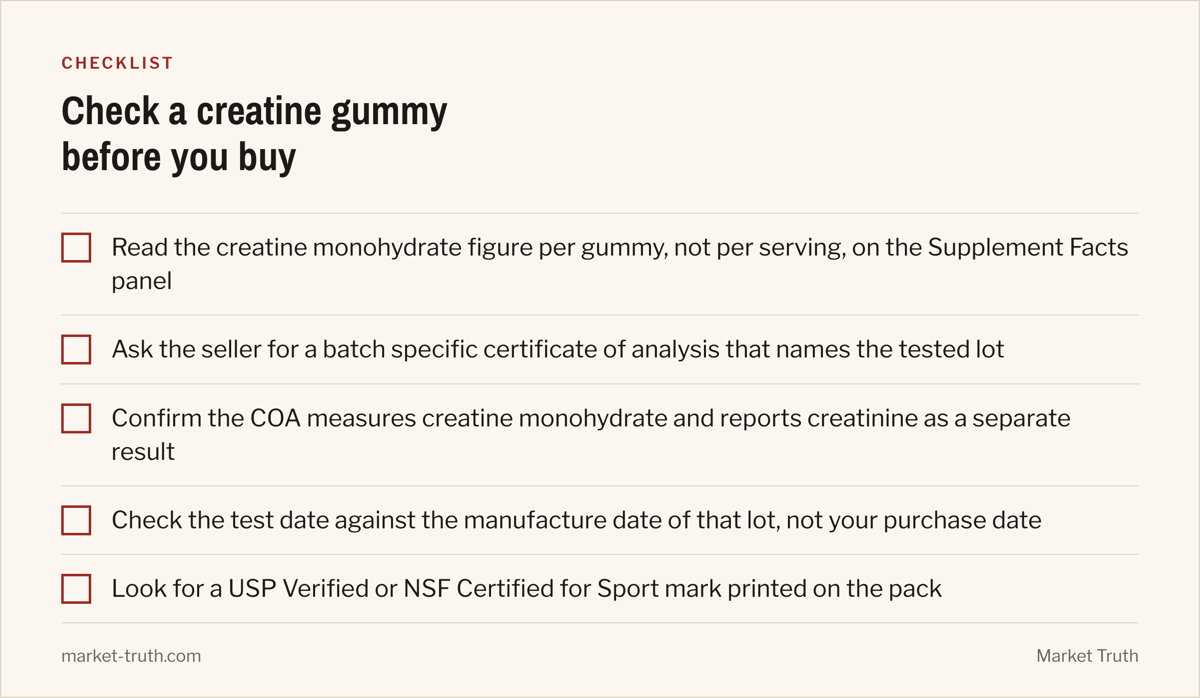
Three things decide whether a COA means anything: which lot it covers, when it was tested, and whether it reports the degradation product. A COA that names no lot number is a marketing document. A COA dated at manufacture tells you nothing about the product on the shelf twelve months later.
For creatine specifically, ask whether the assay reports creatinine alongside creatine. A method that measures total creatine-plus-creatinine, or that reports a single combined figure, will pass a degraded batch. The result you want is creatine monohydrate quantified on its own, from a randomly purchased retail unit, with the analytical method named. Our guide to what third-party tested actually means separates the testing claims you can check from the ones you cannot.
Third-party marks compress that work. The USP Verified Mark indicates the product contains the ingredients listed on the label in the declared potency and amounts (U.S. Pharmacopeia), and NSF Certified for Sport verifies that contents match the label and screens for 290 banned substances (NSF). The difference between the two marks matters if you are drug tested.
Is powdered creatine monohydrate the better buy?
Yes, and it is not close. A 2022 systematic review of 17 randomised placebo-controlled trials examined magnesium-creatine chelate and creatine citrate, malate, ethyl ester, nitrate and pyruvate. It found no consistent performance enhancement among alternative forms of creatine compared with placebo, and a marketplace review showing creatine monohydrate is the lowest-cost form (Journal of Strength and Conditioning Research, 2022).
One trial has tested a gummy delivery form directly. Thirty-two female beach volleyball athletes were assigned to 5 grams per day of creatine monohydrate gummies or a control group for 10 weeks, and the supplemented group improved on jump height and change-of-direction speed (Journal of Functional Morphology and Kinesiology, 2026). It reports a control group rather than a placebo, and the creatine content of the gummies was not independently assayed.
That is the whole evidence base for the format. One small unblinded trial, against decades of monohydrate research.
| Question a buyer should ask | Powdered creatine monohydrate | Creatine gummy |
|---|---|---|
| Is the dose verified before sale? | No. FDA reviews no supplement before marketing. | No. Identical rule, identical risk. |
| Does the form degrade in storage? | Dry powder. Degradation needs moisture and heat. | Residual water plus heat processing drive conversion to creatinine. |
| What is the trial evidence for the format? | The reference form used across the research literature. | One 10 week trial in 32 athletes, unblinded, no content assay. |
| What does it cost per gram? | The lowest-cost form of creatine on the market. | A premium paid for a format with a degradation pathway. |
What claim on a creatine gummy pack is the weakest?
The dose. Flavour, convenience and texture are verifiable by the buyer in ten seconds. The milligram figure is the only claim on the pack that requires an instrument, and it is the one nobody is required to prove before selling you the product. That is my judgement on the category: the gummy format asks you to trust exactly the number you are least able to check.
A structure/function claim on the pack, such as a statement about supporting muscle strength, must carry the disclaimer required by 21 CFR 101.93: “This statement has not been evaluated by the Food and Drug Administration.” That sentence is a legal disclosure, not a quality signal.
Third-party seals help, but they are not a warranty. NIH ODS states plainly that quality seals from independent testers “do not guarantee that a product is safe or effective” (NIH Office of Dietary Supplements). If you have a medical condition or take prescription medication, discuss supplement use with a licensed clinician before starting anything.
How do you tell a real quality signal from a marketing one?
Rank the signals by who carries the cost of being wrong. A third-party certifier that audits the facility and retests off-the-shelf samples has a business that fails if it is wrong. A brand describing its own testing carries no such exposure. A phrase like “lab tested” with no lab, no lot and no date carries none at all.
Apply the same ladder used across this site for telling whether a supplement actually works: independent verification, then a named published method, then a manufacturer document, then a claim on a website. Creatine gummies currently sit at the bottom two rungs for content verification.
The method behind these judgements, including which sources this site will and will not cite, is set out in how we research. The short version is that a vendor’s own summary of a test is not a test result.
Questions readers ask
Does creatinine do anything if a gummy has degraded?
Creatinine is the inert breakdown product of creatine, not an ergogenic compound. A gummy that has converted delivers the byproduct rather than the ingredient, which is why an assay reporting creatine and creatinine separately matters.
Can the FDA pull a creatine gummy that is underdosed?
The FDA can act after a product is on the market, since manufacturers, not the agency, are responsible for evaluating safety and labeling before sale. Enforcement is reactive and depends on the agency learning the product exists.
Are creatine gummies safe even if underdosed?
Safety and potency are separate questions, and an underdosed product is a value problem rather than a hazard on its own. Anyone with a medical condition or on prescription medication should raise supplement use with a licensed clinician.
Do gummy vitamins in general miss their label figures?
Label deviation is documented across supplement formats. An analysis of 52 children's multivitamin products, gummies included, found 23 of 26 declaring manganese exceeded the label, with a mean difference of 42.5 percent.
Does a USP or NSF mark on a gummy prove the dose?
Those marks verify that contents match the label at the time of certification, including off-the-shelf retesting. NIH ODS notes that such seals still do not guarantee a product is safe or effective.
Sources
- FDA, Questions and Answers on Dietary Supplements
- Evaluation of the stability of creatine in solution prepared from effervescent creatine formulations, AAPS PharmSciTech 2003
- Efficacy of Alternative Forms of Creatine Supplementation, J Strength Cond Res 2022
- Development and validation of a qNMR method for quantification of creatine and taurine in sports supplements, Die Pharmazie 2025
- Excessive manganese content in children's multivitamin supplements, PLoS ONE 2026
- Effects of Creatine Monohydrate Gummies on Performance and Body Composition in Female Beach Volleyball Athletes, JFMK 2026
- U.S. Pharmacopeia, USP Verified Mark
- NIH Office of Dietary Supplements, Dietary Supplements: What You Need to Know
Primary sources last checked September 5, 2026.

About Erin Delaney
Erin Delaney is a health science journalist who has spent nine years reading the documents behind health product marketing. She covers dietary supplements, wellness devices and the advertising rules that govern them, working from FDA and FTC filings, NIH Office of Dietary Supplements fact sheets, USP and NSF standards and the primary research literature rather than press releases or vendor claims. Her interest started with one question that nobody on a product page ever answers: if the bottle says clinically proven, who actually checked, and against what? She is not a physician and does not give medical advice. Her job is to show you what the evidence says, and to be equally clear about where it runs out.
Related checks
-
Does liposomal vitamin C actually absorb better?
Liposomal vitamin C raises blood levels in most published trials, but a 2025 scoping review found none of the ten studies measured whether the extra was…