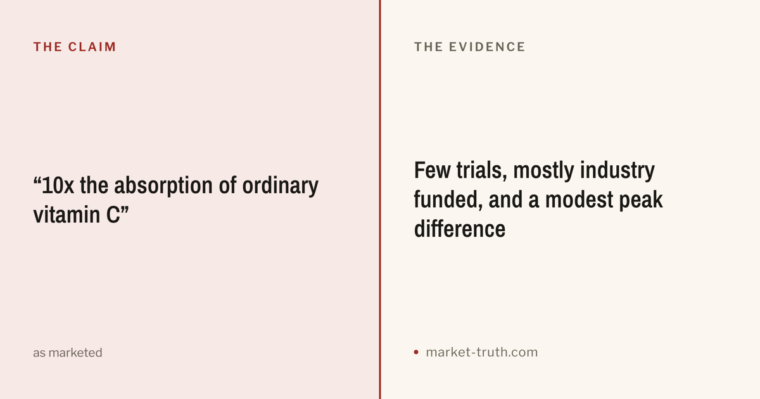
Liposomal vitamin C does raise blood levels more than plain ascorbic acid, but the published evidence is thinner than the advertising. A 2025 scoping review found only 10 studies worldwide, using wildly different formulations and doses from 0.15 to 10 grams. Nine showed higher uptake: 1.2 to 5.4-fold higher peak concentration. None measured how much was then excreted, and only two measured any biological effect.
Does liposomal vitamin C actually absorb better than regular vitamin C?
On the measure the trials used, yes. Blood levels after a liposomal dose run higher than after the same dose of plain ascorbic acid in most published comparisons. That is a genuine finding and this page is not going to pretend otherwise. What it does not establish is that more vitamin C ends up where it does something.
The most complete assessment is a scoping review published in Basic and Clinical Pharmacology and Toxicology. From 321 studies identified, 10 met inclusion criteria: seven randomised crossover designs, one parallel group, two non-randomised. Nine of the 10 reported higher bioavailability for the liposomal form, at 1.2 to 5.4-fold higher peak plasma concentration and 1.3 to 7.2-fold higher area under the curve (Gonzalez and colleagues, 2025).
Ten studies is a small literature for a product category this large. The review authors said directly that the formulations, doses and sampling windows were so different that direct comparison was difficult.
What did the scoping review actually conclude?
That the absorption question is answered and the important questions are not. The review’s stated conclusion was that none of the studies assessed ascorbate elimination, so it is uncertain whether the liposomal-to-standard ratio seen in plasma also appears in urine. Only two of the 10 studies assessed cellular uptake in vivo. Only two assessed any potential biological effect.
Read that as a ratio: eight out of ten studies measured a blood curve and stopped. The review’s recommendation was that future studies should include urinary elimination and cellular uptake kinetics, recruit participants with low baseline vitamin C status, and investigate biological effects.
That is a research field describing its own gap. When a scoping review of an entire product category recommends that somebody finally measure whether the extra vitamin is retained, the marketing claim built on that category is running ahead of its evidence by several years.
What is the difference between a higher peak, more total absorption and a better result?
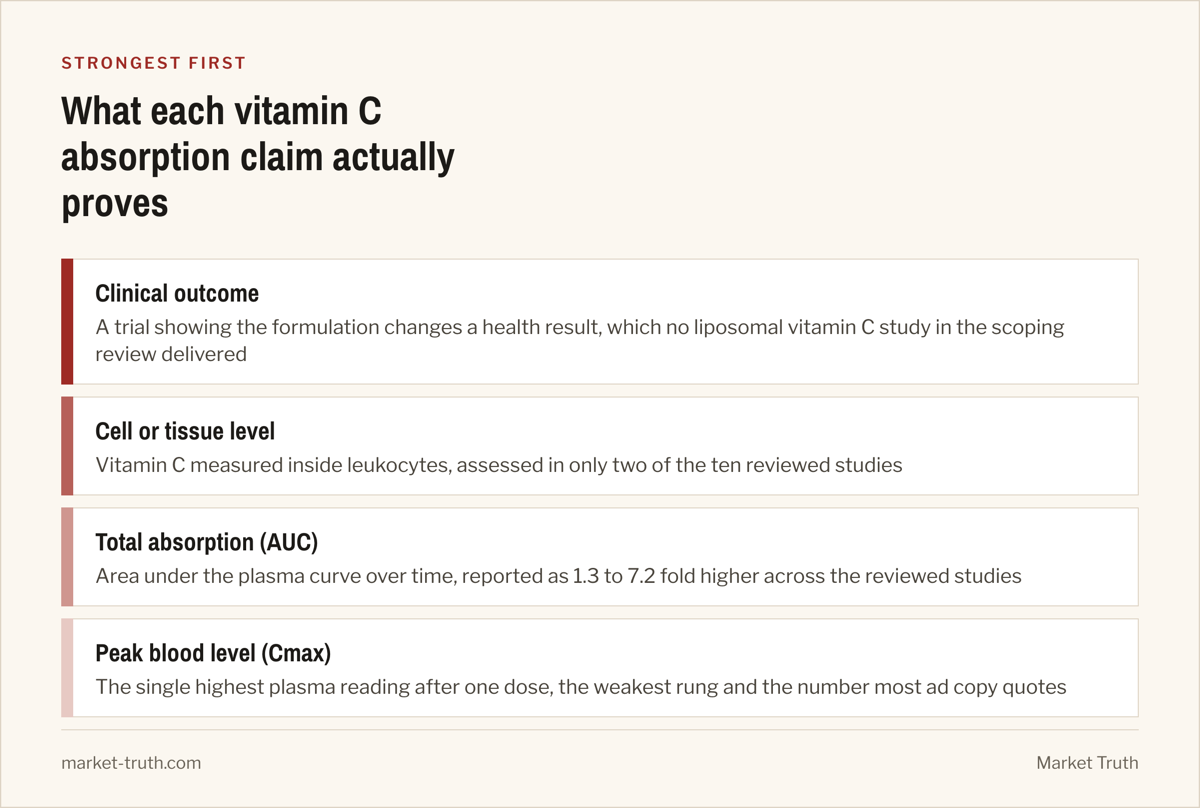
Marketing merges three separate measurements into one word. Cmax is the highest concentration your blood reaches after a dose. AUC is total exposure over time. A clinical outcome is whether anything about your health changed. They are not interchangeable and a product can win on the first two while never being tested on the third.
The scoping review makes the hierarchy concrete. Every included study reported plasma pharmacokinetics. Two reported cellular uptake. Two reported a biological effect of any kind. So a “clinically shown superior absorption” line on a bottle is describing a blood curve, not a health result.
The FTC’s position on this gap is explicit. Under the Health Products Compliance Guidance, marketers “must have at least the level of support that they claim to have”, and substantiation of health-related benefits will generally need to be randomised controlled human clinical testing. A surrogate marker is not the benefit.
| What the ad says | What was measured | What it does not show |
|---|---|---|
| “Absorbs better” | Peak plasma concentration after a single dose | Whether the extra amount is retained or excreted |
| “Higher bioavailability” | Area under the plasma curve, 1.3 to 7.2-fold in 10 studies | Whether tissue or leukocyte levels rose |
| “Clinically studied” | A pharmacokinetic crossover, usually under 30 people | Any change to immunity, illness or symptoms |
| “Up to 10x” | The top end of one formulation in one small trial | That any product on sale reproduces that figure |
Why might a higher blood level not raise tissue levels at all?
Because plasma vitamin C is tightly regulated by the kidney, and the regulation kicks in at doses far below what supplement bottles offer. Once transport is saturated, extra ascorbate is not stored, it is filtered out. Raising the peak of a curve that the body actively flattens is a smaller achievement than it sounds.
The depletion-repletion studies that set the US intake recommendations are the primary evidence here. In seven volunteers hospitalised for four to six months, bioavailability was complete for a single 200 mg dose, and at single doses of 500 mg and higher bioavailability declined and the absorbed amount was excreted (PNAS, 1996). Neutrophils, monocytes and lymphocytes saturated at 100 mg daily.
A parallel study in healthy young women found plasma and circulating cells saturated at 400 mg daily, with urinary elimination of higher doses (PNAS, 2001). If your cells are already saturated, a formulation that raises plasma has nowhere useful to put the surplus.
How big were the trials behind the absorption claims?
Small, and each tested a different thing. This is the detail affiliate pages leave out. A 2024 double-blind randomised crossover trial in 27 adults compared 500 mg of a named commercial liposomal product against 500 mg standard vitamin C and placebo, and reported plasma Cmax 27 percent higher and 24-hour AUC 21 percent higher, with leukocyte AUC 8 percent higher (European Journal of Nutrition, 2024).
Compare that with the top of the range. A randomised, double-blinded three-way crossover in 14 volunteers tested a surface-engineered liposomal calcium ascorbate built with fenugreek galactomannan and reported more than a 7-fold bioavailability increase (RSC Advances, 2021). That is not the same product, the same salt, or the same encapsulation.
Twenty-one percent and 700 percent are both in the literature because they are different formulations in trials of 27 and 14 people. Quoting the ceiling as the category average is the core distortion in this market.
Does “10x absorption” mean anything legally?
It obliges the seller to hold evidence for that exact number, for that exact product. The FTC requires health benefit claims to be substantiated by “competent and reliable scientific evidence”, defined as tests conducted and evaluated objectively by qualified experts and generally accepted in the profession to yield accurate and reliable results.
A specific multiple is a specific claim. Borrowing a 7-fold figure from a fenugreek-galactomannan calcium ascorbate study to sell an unrelated liposomal ascorbic acid does not meet that standard, because the substantiation must fit the product and the claimed effect. The same logic applies to the phrase on the front of the bottle, as covered in what “clinically proven” means on a supplement label.
FTC advertising also covers packaging, labelling, websites, social posts and influencer content, not just paid ads. The claim in a founder’s video is the same claim as the one on the carton.
Is liposomal vitamin C worth the price premium?
For most people, no, and I will say which part of the argument fails. The absorption data is real. The retention data does not exist. Paying a several-fold premium for a higher peak on a curve your kidneys are designed to flatten is paying for the measurement, not the outcome.
The case is stronger for people with genuinely elevated requirements or poor baseline status, which is exactly the population the scoping review said had not been studied. A separate 2025 systematic review of alternative vitamin C forms in healthy adults found some formulations raised leukocyte vitamin C, sometimes without affecting plasma levels, and reported that no study assessed tissue retention (Nutrients, 2025). Anyone considering high-dose vitamin C for a medical reason should raise it with a licensed clinician.
The general test for this class of claim is set out in how to tell if a supplement works, and the substantiation a marketer actually has to hold is set out in who regulates supplement claims. Our sourcing rules are in how we research.
Questions readers ask
What is a liposome in a vitamin C supplement?
A liposome is a lipid vesicle that encapsulates the ascorbate. The scoping review noted that the ten included studies used vastly different liposomal formulations, which is why their reported absorption figures range so widely and cannot be pooled.
Is liposomal vitamin C the same as intravenous vitamin C?
No. Intravenous dosing bypasses the saturable intestinal absorption that limits oral vitamin C entirely. The oral liposomal trials in the scoping review compared oral formulations against each other, not against any infused route.
How much vitamin C saturates the body?
Depletion-repletion research found circulating cells saturated at 100 mg daily in men, and plasma and circulating cells saturated at 400 mg daily in young women, with higher doses eliminated in urine.
Do liposomal vitamin C products cause less stomach upset?
A 2025 systematic review of alternative vitamin C forms reported better tolerability and fewer epigastric adverse events for calcium ascorbate with metabolites versus ascorbic acid. Tolerability is a separate question from absorption.
Should you take vitamin C with food?
Absorption efficiency falls with dose regardless of timing, and the trials reviewed dosed under fasting conditions. Anyone managing a medical condition should discuss dosing with a licensed clinician rather than a product page.
Sources
- Do Liposomal Vitamin C Formulations Have Improved Bioavailability? A Scoping Review, Basic Clin Pharmacol Toxicol 2025
- Liposomal delivery enhances absorption of vitamin C into plasma and leukocytes, Eur J Nutr 2024
- Surface-engineered liposomal particles of calcium ascorbate, RSC Advances 2021
- Vitamin C pharmacokinetics in healthy volunteers: evidence for a recommended dietary allowance, PNAS 1996
- A new recommended dietary allowance of vitamin C for healthy young women, PNAS 2001
- Enhanced Vitamin C Delivery: A Systematic Literature Review, Nutrients 2025
- FTC, Health Products Compliance Guidance
- NIH Office of Dietary Supplements, Dietary Supplements: What You Need to Know
Primary sources last checked September 5, 2026.

About Erin Delaney
Erin Delaney is a health science journalist who has spent nine years reading the documents behind health product marketing. She covers dietary supplements, wellness devices and the advertising rules that govern them, working from FDA and FTC filings, NIH Office of Dietary Supplements fact sheets, USP and NSF standards and the primary research literature rather than press releases or vendor claims. Her interest started with one question that nobody on a product page ever answers: if the bottle says clinically proven, who actually checked, and against what? She is not a physician and does not give medical advice. Her job is to show you what the evidence says, and to be equally clear about where it runs out.
Related checks
-
Do creatine gummies actually contain creatine?
Creatine degrades to creatinine in moisture and heat, which describes a gummy exactly, and no agency verifies the dose on the pack before it is sold.