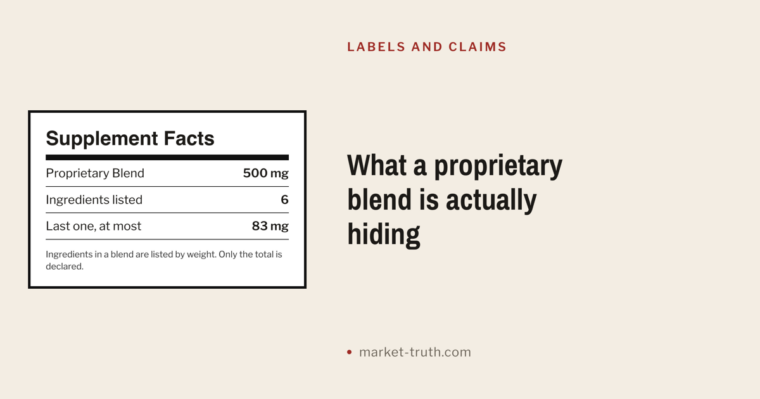
A proprietary blend is a labeling choice, not a trade secret. Under 21 CFR 101.36(c), a manufacturer may group ingredients under one name, list them in descending order by weight, and declare only the combined total. Nothing tells you how much of each ingredient you get. The arithmetic gives you a ceiling and nothing more, which makes the studied-dose check impossible.
What does proprietary blend mean on a supplement label?
It means the manufacturer has grouped several dietary ingredients under one heading and declared a single combined weight for the group. The individual amounts are not disclosed. The regulation permits this and sets the format precisely, so a blend panel is a compliance choice made on purpose.
21 CFR 101.36(c) states that a proprietary blend “shall be included in the list of dietary ingredients” and “identified by the term ‘Proprietary Blend’ or other appropriately descriptive term or fanciful name and may be highlighted by bold type.” The fanciful name is why you see panels labeled Focus Matrix or Energy Complex rather than the plain term.
Two subparagraphs do the real work. Paragraph (c)(2) requires the ingredients inside the blend to be “declared in descending order of predominance by weight,” indented under the blend name. Paragraph (c)(3) requires the declared weight to be “the total weight of all other dietary ingredients contained in the proprietary blend.” Read the full nutrition labeling rule for dietary supplements.
How much of each ingredient is in a proprietary blend?
You cannot know. You can only calculate a ceiling. Because the ingredients are ordered by weight, the ingredient in position two cannot exceed half the blend total, position three cannot exceed a third, and so on. That upper bound is the only real number the label gives you.
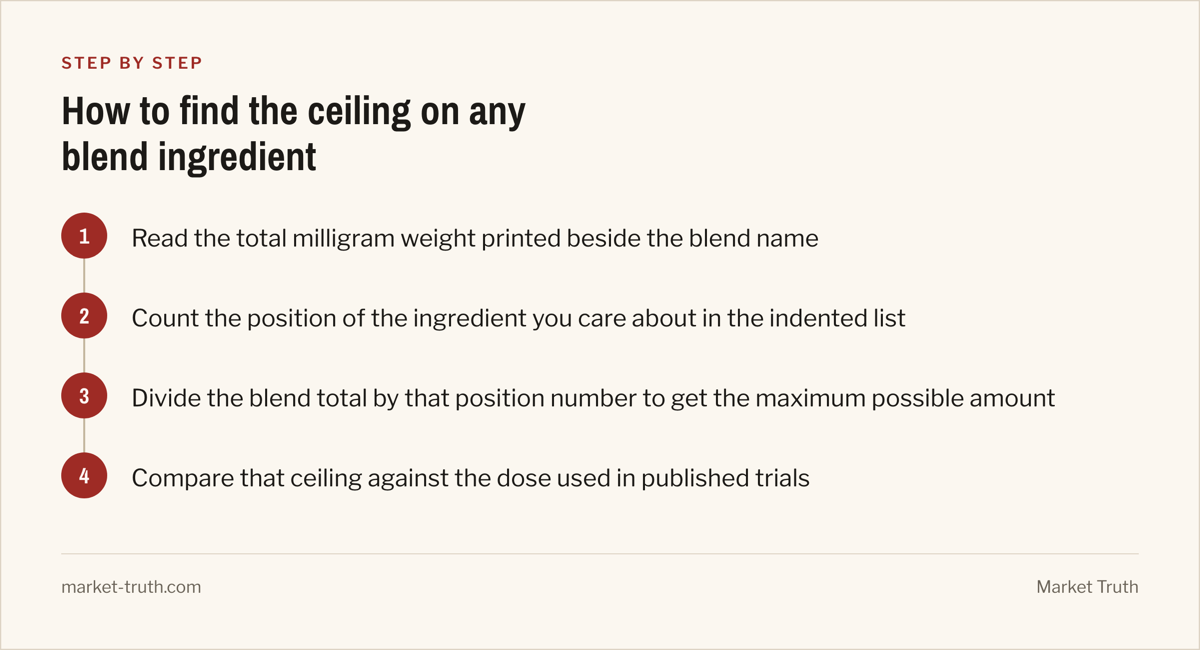
The logic is simple. If an ingredient sits in position n, then the n ingredients above and including it are each at least as heavy as it is. Their combined weight cannot exceed the declared blend total. So that ingredient’s maximum possible amount is the blend total divided by its position number.
Here is what that looks like for a 500 mg blend containing five ingredients.
| Position in the blend | Maximum possible amount | Why that is the ceiling |
|---|---|---|
| 1st listed | 500 mg | Could account for the entire declared total |
| 2nd listed | 250 mg | Cannot exceed the ingredient above it |
| 3rd listed | 167 mg | Three ingredients at this weight would fill the blend |
| 4th listed | 125 mg | Four ingredients at this weight would fill the blend |
| 5th listed | 100 mg | Five ingredients at this weight would fill the blend |
What happens when the first ingredient in the blend is a filler?
The ceiling collapses for everything below it. A cheap bulk ingredient in position one can legally occupy most of the declared total, leaving the ingredients you actually bought the product for to share whatever remains. The label discloses none of this, and the panel still complies.
Take the same 500 mg blend. If the first-listed ingredient is a low-cost carrier at 460 mg, the remaining four ingredients share 40 mg between them. The fifth-listed ingredient could be present at a few milligrams. The panel would be identical to one where the ingredients are evenly split.
Position in a blend tells you the rank order, never the gap between ranks.
This is the practical failure of the format. Two products with the same blend name, the same ingredient list and the same declared total can differ by two orders of magnitude in the amount of the ingredient that matters. Nothing on either label distinguishes them, and nothing in the regulation requires it to.
Is a proprietary blend legal?
Yes, and that is the point worth understanding. 21 CFR 101.36(c) explicitly authorises the format and even provides a sample label illustrating it. A blend panel is not a violation, not a loophole and not evidence of bad faith. It is a disclosure option written into the labeling rule.
The regulation still imposes limits. Paragraph (c)(1) requires that any ingredient inside the blend for which FDA has established a Reference Daily Intake or Daily Reference Value must be declared separately with its own quantitative amount. Vitamins and minerals with established values cannot hide inside the blend. Only the “other dietary ingredients,” meaning botanicals, amino acids and similar, can be grouped.
What makes the format consequential is what sits behind it. As the FDA states in its Questions and Answers on Dietary Supplements, the agency does not approve dietary supplements before they are marketed and generally does not review labeling before use. Nobody checks the blend against the formulation. For how that responsibility is divided, see who regulates supplement claims.
Does a proprietary blend protect the formula from competitors?
Barely. The full ingredient list is printed on the label in rank order, which is most of the formula. A competitor with a mass spectrometer and a retail sample can reconstruct the quantities in an afternoon. The person the format actually withholds information from is the buyer.
That asymmetry is the honest description. Reverse engineering a supplement is routine analytical chemistry, and contract manufacturers work from the same short list of commodity ingredients. The competitive secrecy argument assumes a rival who cannot afford a lab, which is not the rival that matters.
Meanwhile the buyer holds a label that names every ingredient and quantifies none of them. If a brand genuinely wants to protect a ratio, it can. It cannot simultaneously claim the blend is scientifically validated at a specific dose while refusing to print that dose. Those two positions do not coexist.
Can I check a proprietary blend against the dose used in studies?
No, and that is the effect that matters most. The single most useful check on any supplement is comparing the amount in the product against the amount used in the trials that generated the claim. A blend panel removes the number that check depends on.
NIH’s Office of Dietary Supplements publishes fact sheets for vitamins, minerals, herbs, botanicals and probiotics, in parallel consumer and health-professional versions, and those sheets carry the studied intakes. You can browse the complete ODS fact sheet list. The comparison only works if the label gives you a figure to compare.
Third-party verification does not rescue it either. The USP Verified Mark confirms that a product contains the ingredients listed on the label “in the declared potency and amounts,” per USP’s description of the mark. For a blend, the declared amount is the blend total. Verification confirms the total is right, which was never the question you had.
How should I judge a product with a proprietary blend?
Treat the blend as a claim about disclosure, not about the product’s quality. Run the ceiling calculation on the ingredient the marketing is built around. If that ceiling sits below the dose used in published research, the marketing claim is unsupported by the label in front of you.
Four things worth doing before you buy:
- Find the ingredient the sales page names as the active one, and note its position in the blend.
- Divide the blend total by that position to get its maximum possible amount.
- Look up the studied intake for that ingredient on an NIH ODS fact sheet.
- If the ceiling is below the studied intake, the product cannot deliver the claimed effect at any formulation.
My judgement: a blend panel is a yellow flag, not a red one, unless the brand also advertises a specific clinical result. A claim of proven efficacy alongside an undisclosed dose is the weakest combination on a supplement label, and it connects directly to the substantiation problem in what clinically proven really means on a supplement label. If you want independent confirmation of what is actually in the bottle, the programmes that test finished product are compared in what third-party tested actually means. Our method is set out in how we research.
Anyone taking a supplement alongside prescribed medication should raise the ingredient list with a licensed clinician or pharmacist.
Questions readers ask
Do proprietary blends have to list every ingredient they contain?
Yes. Every dietary ingredient in the blend must appear by its common or usual name, indented under the blend heading and ranked by weight. The regulation withholds the individual quantities, not the identities.
Can a vitamin or mineral be hidden inside a proprietary blend?
No. 21 CFR 101.36(c)(1) requires any ingredient with an established Reference Daily Intake or Daily Reference Value to be declared separately with its own quantitative amount, outside the blend grouping.
Does FDA review a proprietary blend panel before the product ships?
No. FDA states it does not approve dietary supplements before marketing and generally does not review supplement labeling before use. Compliance is assessed only after the product reaches the market.
Is a blend total the same as the serving size?
No. The blend total is the combined weight of the grouped ingredients only. A serving can contain several blends plus separately declared ingredients, so the totals will not match the serving weight.
Why do brands use a fanciful name instead of the words proprietary blend?
The regulation permits a fanciful name in place of the term, and allows bold type. That is how a disclosure grouping ends up presented as a branded formula on the front of the package.
Sources
- 21 CFR 101.36, Nutrition labeling of dietary supplements
- FDA, Questions and Answers on Dietary Supplements
- FDA, Dietary Supplements
- NIH Office of Dietary Supplements, Dietary Supplement Fact Sheets
- NIH Office of Dietary Supplements, Dietary Supplements: What You Need to Know
- U.S. Pharmacopeia, USP Verified Mark
- FDA, Label Claims for Conventional Foods and Dietary Supplements
Primary sources last checked September 5, 2026.

About Erin Delaney
Erin Delaney is a health science journalist who has spent nine years reading the documents behind health product marketing. She covers dietary supplements, wellness devices and the advertising rules that govern them, working from FDA and FTC filings, NIH Office of Dietary Supplements fact sheets, USP and NSF standards and the primary research literature rather than press releases or vendor claims. Her interest started with one question that nobody on a product page ever answers: if the bottle says clinically proven, who actually checked, and against what? She is not a physician and does not give medical advice. Her job is to show you what the evidence says, and to be equally clear about where it runs out.
Related checks
-
What the FDA disclaimer on a supplement bottle actually tells you
The FDA disclaimer on a supplement bottle is triggered by the manufacturer's own claim, and the evidence behind that claim is never filed with anyone.
-
What “clinically proven” actually means on a supplement label
"Clinically proven" has no agency definition, yet the FTC rule that marketers must hold the support they claim turns the phrase into a legal obligation nobody…
-
Is FDA registered the same as FDA approved? No, and the gap is enormous
FDA registered, FDA registered facility, FDA approved facility and FDA compliant are four different claims, and only one of them is outright false.