The disclaimer is a trigger, not boilerplate. It appears because the manufacturer chose to make a structure/function claim, which is what activates 21 CFR 101.93. The exact wording, the boldface, the one-sixteenth-inch minimum type and the placement are all mandated. What the disclaimer does not tell you is who did evaluate the claim, and the answer is nobody outside the company.
What does not intended to diagnose, treat, cure, or prevent any disease mean?
It means the manufacturer made a claim about the product’s effect on the structure or function of the body, notified FDA that it did so, and is required by regulation to carry a fixed disclaimer alongside it. The sentence is a legal consequence of a marketing decision.
21 CFR 101.93(b) explains the trade. The requirements apply where a supplement bears a statement provided for by section 403(r)(6) of the Federal Food, Drug, and Cosmetic Act and the manufacturer “wishes to take advantage of the exemption to section 201(g)(1)(C)” of the act. That exemption is what keeps the product a supplement rather than an unapproved drug.
So the disclaimer marks a specific bargain: the firm gets to say the product supports something, and in exchange it prints a sentence saying FDA has not evaluated the statement. Read the full text of 21 CFR 101.93. For the wider division of responsibility, see who regulates supplement claims.
What is the exact wording the regulation requires?
Two forms, and they are fixed word for word. 21 CFR 101.93(c)(1) governs a single statement and (c)(2) governs multiple statements. A manufacturer cannot soften, shorten or paraphrase either version. If the text on a bottle differs from these, the label is out of compliance.
The singular form, required where there is one statement:
This statement has not been evaluated by the Food and Drug Administration. This product is not intended to diagnose, treat, cure, or prevent any disease.
The plural form, permitted where more than one such statement appears on the label or in the labeling:
These statements have not been evaluated by the Food and Drug Administration. This product is not intended to diagnose, treat, cure, or prevent any disease.
Under (c)(2) the manufacturer has a choice: repeat the singular disclaimer on every statement, or use the plural version once, placed according to paragraph (d). Both satisfy the rule.
How is the disclaimer required to be printed?
In boldface, at a minimum type size, adjacent to the claim or linked to it by a symbol, and boxed when it is not adjacent. These are not stylistic conventions. Paragraphs (d) and (e) of 21 CFR 101.93 specify them, which is why the disclaimer looks the same across brands.
Paragraph (e) states the disclaimer “shall appear in boldface type in letters of a typesize no smaller than one-sixteenth inch.” Paragraph (d) requires it to be “placed adjacent to the statement with no intervening material or linked to the statement with a symbol (e.g., an asterisk) at the end of each such statement.”
Two placement rules get missed. On product labels and in labeling such as pamphlets and catalogs, the disclaimer “shall appear on each panel or page where there such is a statement.” And it “shall be set off in a box where it is not adjacent to the statement in question.” A brochure making claims on four pages needs the disclaimer on four pages.
| Claim type | Reviewed by FDA before marketing? | Disclaimer required? |
|---|---|---|
| Structure/function claim on a supplement | No. A notice of the wording is filed after marketing begins | Yes, in the exact 101.93(c) wording |
| NLEA authorized health claim | Yes. Reviewed and authorized by regulation | No |
| Structure/function claim on a conventional food | No, and no notification is required either | No |
So who evaluated the claim, if not the FDA?
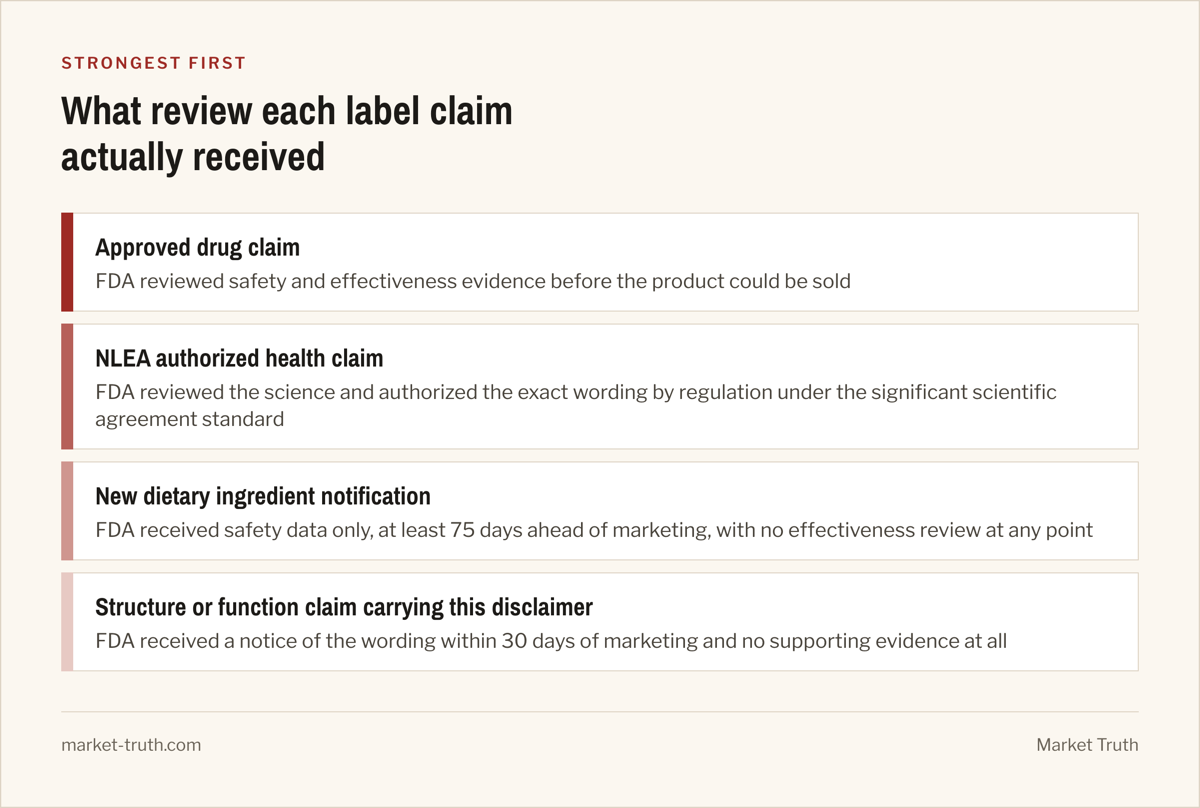
The company that sells it, and nobody else. This is the question the disclaimer raises and never answers. The manufacturer is required to hold substantiation, and is required to certify that it holds it, but the substantiation itself is never filed with FDA and never reviewed by anyone.
Look at what the notification actually contains. Under 21 CFR 101.93(a)(2), the firm submits its name and address, the text of the statement, the name of the dietary ingredient, and the product name. That is the complete list. No studies, no data, no dose rationale.
Paragraph (a)(3) requires only that a responsible individual “certify that the information contained in the notice is complete and accurate, and that the notifying firm has substantiation that the statement is truthful and not misleading.” A certification that evidence exists is not evidence. And the notice is due no later than 30 days after first marketing, so the product is already on shelves when FDA hears about it.
FDA states plainly in its Questions and Answers on Dietary Supplements that because it does not approve supplements before marketing, the agency “often does not know when new products come on the market.” NIH’s Office of Dietary Supplements puts it more directly: FDA “does not determine whether dietary supplements are effective before they are marketed.”
Does the disclaimer mean the supplement does not work?
No, and treating it that way is the common error. The disclaimer says nothing about efficacy in either direction. It reports a procedural fact: this specific statement did not pass through FDA review. Some supplements carrying it work. Some do not. The label cannot tell you which.
What the disclaimer does is shift the burden entirely onto you. Since no agency has vetted the claim, the only evidence check available is the one you run yourself: find the ingredient, find the dose, find the trials, compare. NIH ODS publishes fact sheets that make that comparison possible for most common ingredients.
The disclaimer is a statement about process, not about the product.
It is also worth noticing what the disclaimer is not. It is not an admission, not a warning and not a safety notice. Reading it as any of those three is exactly the confusion that makes phrases like “FDA registered facility” so effective in marketing, which I unpack in FDA registered versus FDA approved.
What happens if a supplement makes a disease claim anyway?
The disclaimer stops protecting it. 21 CFR 101.93(f) states that if a product marketed as a supplement bears a disease claim, it “will be subject to regulation as a drug unless the claim is an authorized health claim for which the product qualifies.” Printing the disclaimer does not cure a disease claim.
Paragraph (g)(1) defines disease as damage to an organ, part, structure or system such that it does not function properly, giving cardiovascular disease as an example, or a state of health leading to such dysfunction, giving hypertension. Diseases from essential nutrient deficiencies, such as scurvy and pellagra, are excluded.
Paragraph (g)(2) sets out ten criteria for identifying a disease claim, and they reach further than most readers expect. A claim can be implied by the product’s name, by cited publications, by pictures, vignettes or symbols. FDA states it “will consider the context in which the claim is presented.” A product called ArthriEase carrying the disclaimer has still made a disease claim through its name.
How should I read a bottle that carries the disclaimer?
Read the claim it is attached to, not the disclaimer itself. The disclaimer is constant across the category and carries no information about any particular product. The variable is the sentence it sits next to, and that sentence is what the company chose to be legally responsible for.
FDA’s own permitted structure/function examples show how narrow these statements are meant to be: “calcium builds strong bones,” “fiber maintains bowel regularity,” “antioxidants maintain cell integrity.” Compare those to “adequate calcium throughout life may reduce the risk of osteoporosis,” which is an authorized health claim requiring premarket review. See FDA’s page on label claims.
Advertising is a separate track with a higher bar. The FTC’s Health Products Compliance Guidance requires “competent and reliable scientific evidence” for health benefit claims, and its definition of advertising expressly covers packaging and labeling, websites, social media and influencer marketing. A disclaimer on the bottle does not lower that standard, which matters most when a brand also says the product is clinically proven, as covered in what clinically proven means on a supplement label. Our sourcing rules are in how we research.
Discuss any supplement you are considering with a licensed clinician, particularly if you take prescription medication.
Questions readers ask
Is the disclaimer required on conventional foods too?
No. FDA does not require conventional food makers to notify the agency of structure/function claims, and no disclaimer is required on those products. The notification and disclaimer rules are specific to dietary supplements.
Can a supplement legally skip the disclaimer?
Only by making no structure/function claim at all. A label that carries such a statement without the mandated disclaimer, boldface and placement is out of compliance with 21 CFR 101.93.
Does the disclaimer apply to a company's website and social posts?
The regulation covers the label and labeling, including pamphlets and catalogs, on each panel or page carrying a statement. Separately, the FTC treats websites, social media and influencer content as advertising subject to substantiation.
Who can act if a supplement claim turns out to be false?
Both agencies. FDA is generally responsible for supplement safety, quality and labeling, and FTC is generally responsible for advertising. Each can bring enforcement actions, and FDA acts after the product reaches the market.
What is the difference between a disease claim and a structure/function claim?
A disease claim asserts an effect on a specific disease, its signs or symptoms. A structure/function claim describes an effect on normal body structure or function. Only the second one keeps the product regulated as a supplement.
Sources
- 21 CFR 101.93, Certain types of statements for dietary supplements
- FDA, Questions and Answers on Dietary Supplements
- FDA, Dietary Supplements
- FDA, Label Claims for Conventional Foods and Dietary Supplements
- NIH Office of Dietary Supplements, Dietary Supplements: What You Need to Know
- NIH NCCIH, Dietary and Herbal Supplements
- FTC Health Products Compliance Guidance (December 2022)
- FDA, New Dietary Ingredient (NDI) Notification Process
Primary sources last checked September 5, 2026.

About Erin Delaney
Erin Delaney is a health science journalist who has spent nine years reading the documents behind health product marketing. She covers dietary supplements, wellness devices and the advertising rules that govern them, working from FDA and FTC filings, NIH Office of Dietary Supplements fact sheets, USP and NSF standards and the primary research literature rather than press releases or vendor claims. Her interest started with one question that nobody on a product page ever answers: if the bottle says clinically proven, who actually checked, and against what? She is not a physician and does not give medical advice. Her job is to show you what the evidence says, and to be equally clear about where it runs out.
Related checks
-
What a proprietary blend on a supplement label is actually hiding
A proprietary blend declares only a combined weight, so the arithmetic gives you a ceiling on each ingredient and never an actual dose.
-
What “clinically proven” actually means on a supplement label
"Clinically proven" has no agency definition, yet the FTC rule that marketers must hold the support they claim turns the phrase into a legal obligation nobody…
-
Is FDA registered the same as FDA approved? No, and the gap is enormous
FDA registered, FDA registered facility, FDA approved facility and FDA compliant are four different claims, and only one of them is outright false.