"Clinically proven" is not defined, reviewed or approved by any US agency. No regulator signs off on the phrase before the bottle ships. It still creates a real legal obligation: the FTC requires marketers to hold at least the level of support they claim to have, so the words commit a brand to randomized human evidence for that exact benefit at that exact dose. Almost nobody checks in advance.
What does “clinically proven” mean on a supplement label?
It means the brand has asserted that clinical research proves the specific benefit named next to it. That is all it means. There is no agency definition, no application, no file number and no premarket review behind the phrase. The obligation is entirely retrospective and entirely on the marketer.
Under the Dietary Supplement Health and Education Act of 1994, the FDA does not approve dietary supplements before they are marketed and generally does not approve supplement claims or labeling before use. The FDA also states that a firm making a structure/function claim must have substantiation that the claim is truthful and not misleading, but that substantiation is never filed with or reviewed by the agency.
So the sequence is: the brand writes “clinically proven”, prints it, ships it, and only then becomes vulnerable to an enforcement action it will probably never face. The claim is checked after the fact or not at all.
Which agency polices the phrase, the FDA or the FTC?
The FTC. The FDA is generally responsible for supplement safety, quality and labeling; the FTC is generally responsible for advertising, and both can bring enforcement actions. Because the FTC defines advertising to include packaging and labeling, the bottle itself is an ad.
That definition matters more than most shoppers realise. The FTC Health Products Compliance Guidance expressly extends “advertising” to packaging and labeling, brochures, websites, social media and influencer marketing, press releases and interviews, trade shows, and promotion made indirectly through healthcare practitioners. A claim on the carton, a claim in a paid Instagram post and a claim a practitioner repeats in a clinic are treated the same way.
The FTC states that since 1998 it has settled or adjudicated more than 200 cases involving false or misleading advertising claims about the benefits or safety of dietary supplements or other health-related products. Spread across a market with tens of thousands of products, that is not a deterrent. It is a rounding error. My reporting on who actually regulates supplement claims covers the split in full.
What evidence does a brand need before writing “clinically proven”?
Randomized, controlled human clinical testing on the advertised product, for the advertised benefit, at the advertised dose. The FTC’s substantiation standard is “competent and reliable scientific evidence”, and the guidance states that health-benefit substantiation will as a general matter need to take the form of randomized, controlled human clinical testing.
The FTC defines competent and reliable scientific evidence as tests, analyses, research or studies conducted and evaluated in an objective manner by experts in the relevant disease, condition or function, and generally accepted in the profession to yield accurate and reliable results. The research must also be sufficient in quality and quantity when considered in light of the entire body of relevant evidence.
Layered on top is the rule that does the real work. The FTC guidance states that marketers of health-related products must have at least the level of support that they claim to have. A brand that says “studied” needs studies. A brand that says “proven” needs proof.
Can a picture make a “clinically proven” claim?
Yes. Imagery alone can create the claim with no words at all. The FTC treats the net impression of an ad as the claim, so lab coats and microscopes carry the same legal weight as the sentence they replace.
FTC Example 1 in the compliance guidance describes a weight-loss brochure showing images of doctors in white lab coats looking through microscopes, molecular structures and a stack of medical journals. The guidance concludes these images give an impression of scientific legitimacy and likely convey an implied claim that the product has been clinically proven to be effective for weight loss.
The same logic reaches the FDA side. Under 21 CFR 101.93(g)(2), a statement becomes a regulated disease claim if it conveys an effect on a disease explicitly or implicitly, including through the product’s name, cited publications, pictures, vignettes or symbols. Pictures are claims in both regimes. Read the packaging photography as copy.
Why does a real study often not support the claim on the box?
Because the study measured something narrower than the claim, or tested a dose the capsule does not contain. Both failures are common, both are documented in FTC enforcement, and neither is visible from the front of the pack. The study can be genuine and the claim still deceptive.
FTC Example 35 addresses brain training software advertised as “clinically proven to improve memory”. The clinical study used three laboratory tasks testing working memory, the short-term mental manipulation of information such as numbers. The guidance holds that statistically significant gains on those tasks do not support a general memory claim, because other types of memory were never tested.
The dose failure is starker. The FTC guidance cites its consent order in NBTY, Inc., settling charges that claims about 100 mg of DHA promoting healthy brain and eye development in children were deceptive for a supplement containing only 100 mcg of DHA. That is a thousandfold gap between the studied amount and the shipped amount, sitting behind the same words.
What is each phrase actually worth?
Four phrases sit on a ladder, and only the top rung asserts proof. The FTC judges each by what a shopper takes from it, not by what the brand meant. The lower three rungs are engineered to sound like the top one while committing to almost nothing.
| Phrase on the pack | Level of support it asserts | What the marketer must actually hold | Weight it deserves |
|---|---|---|---|
| Clinically proven | Proof of the named benefit | RCT evidence on this product, this dose, this outcome | High, if the trial is named and the dose matches |
| Clinically tested ingredient | Implies the results proved a benefit | Same as above, per FTC Example 18, plus evidence the finished product delivers it | Moderate, and only for the ingredient |
| Studied, research-backed | Research exists on the ingredient | Studies that are relevant to the product and claim | Low, says nothing about outcome or dose |
| Science-inspired, formulated with researched nutrients | None | Nothing specific | Zero, treat as decoration |
The second rung is the one to watch. FTC Example 18 describes a sports drink touting a “clinically tested ingredient” for blood flow and endurance, and finds the phrase implies not just that the ingredient was tested but that the results prove the benefit, and that the drink will deliver it.
How do I find and read the asterisk footnote?
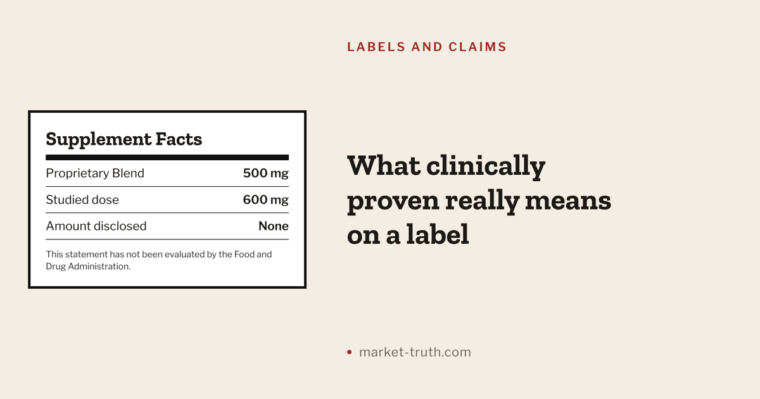
Turn the bottle over and find the boxed sentence near the Supplement Facts panel. It reads: “This statement has not been evaluated by the Food and Drug Administration. This product is not intended to diagnose, treat, cure, or prevent any disease.” That disclaimer is the tell.
Its exact wording is fixed by 21 CFR 101.93(c)(1), with a plural form at (c)(2). Under 101.93(d) and (e) it must appear in boldface type no smaller than one-sixteenth inch, adjacent to the claim or linked to it by a symbol, and boxed where it is not adjacent. That symbol is your map. Trace the asterisk from the front-of-pack claim to the box, and you have found which specific claim the brand is disclaiming.
The disclaimer also marks a boundary. Under 101.93(f), a supplement bearing a disease claim is subject to regulation as a drug unless the claim is an authorized health claim the product qualifies for. Compare that with the FDA’s own examples: “calcium builds strong bones” is a permitted structure/function claim, while “adequate calcium throughout life may reduce the risk of osteoporosis” is an authorized health claim that required FDA premarket review under the significant scientific agreement standard.
The judgement call
Of the four rungs, “clinically tested ingredient” is the most deceptive phrase in the category, and it is worse than the bare word “proven”. “Proven” is a loud claim that invites scrutiny. “Clinically tested ingredient” is quiet, sounds modest and technical, and shifts the subject from the product you are buying to a molecule that appeared in someone’s trial at an unstated dose. It buys the credibility of a clinical trial while surrendering the burden of one.
My rule when reading a label: if the front of the pack claims proof and the back does not name the trial, the dose and the outcome measured, treat the claim as unsupported. Absence of that detail is itself the finding. The method behind these verdicts is published in full.
Two related distinctions matter here. “FDA registered” is a filing obligation and not an endorsement, which I unpack in FDA registered versus FDA approved. And a third-party seal answers a different question again, covered in USP Verified versus NSF Certified: those marks address what is in the bottle, never whether it works. The NIH Office of Dietary Supplements states plainly that the FDA does not determine whether dietary supplements are effective before they are marketed.
If you are weighing a supplement for a specific health condition, discuss it with a licensed clinician who knows your history and your medications.
Questions readers ask
Does the FDA have to see a study before a brand prints "clinically proven"?
No. The FDA states it does not approve supplement claims or labeling before use. A firm must hold substantiation for a structure/function claim, but that substantiation is never filed with or reviewed by the agency at any point.
Can a testimonial substitute for a clinical trial?
No. Under 16 CFR 255.2(a), consumer endorsements are not competent and reliable scientific evidence. The advertiser must hold the same substantiation it would need had it made the claim itself, directly and in its own voice.
Does the FTC rule apply to influencer posts and podcast reads?
Yes. The FTC defines advertising to include packaging and labeling, websites, social media and influencer marketing, press releases, interviews, trade shows, and promotion made indirectly through healthcare practitioners. The channel does not change the substantiation burden.
What penalty can a false "clinically proven" claim carry?
The FTC can bring an enforcement action, and it reports more than 200 settled or adjudicated cases involving false or misleading health-product claims since 1998. Remedies are set case by case rather than by a fixed schedule.
Is "clinically proven" allowed on a conventional food?
The FTC standard applies identically to foods, since its guidance covers foods, OTC drugs, homeopathic products, health equipment, diagnostic tests and health apps. The FDA's supplement-specific notification and disclaimer rules do not apply to conventional foods.
Sources
- FTC, Health Products Compliance Guidance
- 21 CFR 101.93, Certain types of statements for dietary supplements
- FDA, Questions and Answers on Dietary Supplements
- FDA, Label Claims for Conventional Foods and Dietary Supplements
- NIH Office of Dietary Supplements, Dietary Supplements: What You Need to Know
- 16 CFR 255.2, Consumer endorsements
- FDA Consumer Update, Is It Really "FDA Approved"?
Primary sources last checked September 5, 2026.

About Erin Delaney
Erin Delaney is a health science journalist who has spent nine years reading the documents behind health product marketing. She covers dietary supplements, wellness devices and the advertising rules that govern them, working from FDA and FTC filings, NIH Office of Dietary Supplements fact sheets, USP and NSF standards and the primary research literature rather than press releases or vendor claims. Her interest started with one question that nobody on a product page ever answers: if the bottle says clinically proven, who actually checked, and against what? She is not a physician and does not give medical advice. Her job is to show you what the evidence says, and to be equally clear about where it runs out.
Related checks
-
Is FDA registered the same as FDA approved? No, and the gap is enormous
FDA registered, FDA registered facility, FDA approved facility and FDA compliant are four different claims, and only one of them is outright false.