Copper compression sleeves make two claims stacked into one product. Compression has genuine, if modest and contested, trial evidence for recovery after exercise. Copper has none: randomised placebo-controlled trials of copper worn on the skin in arthritis found no effect, and the FTC sued a leading copper apparel marketer for deceptive pain claims. Buy the compression. The copper is decoration.
Are copper compression sleeves proven to work?
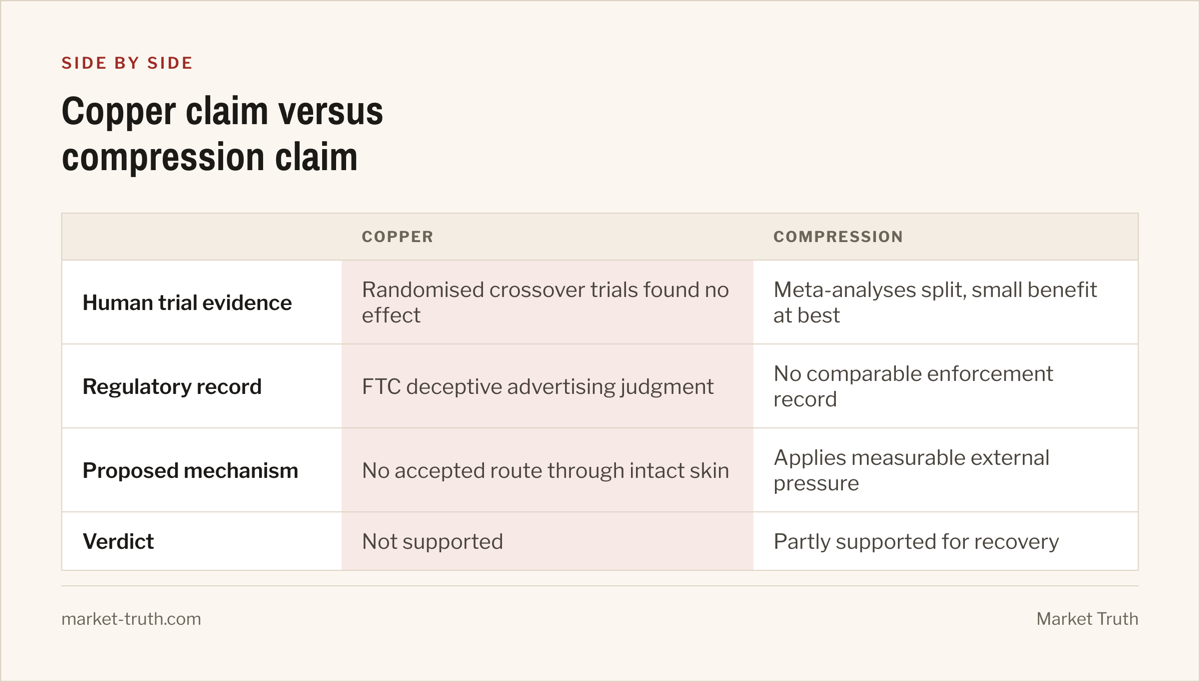
Not as sold. The compression half of the product has published human trial evidence, and the results are mixed but not empty. The copper half has been tested in randomised placebo-controlled trials and failed. Nothing in the regulatory record treats copper-infused fabric as a proven analgesic.
Grading the product as a single thing is the error every seller relies on. A sleeve that applies measurable pressure to a limb and a sleeve that contains copper ions are two separate interventions with two separate evidence bases. One of them is doing all the work.
The Federal Trade Commission takes the same view of stacked claims. Under the FTC’s Health Products Compliance Guidance, health benefit claims require substantiation in the form of “competent and reliable scientific evidence,” and the FTC states that substantiation of health-related benefits “will need to be in the form of randomized, controlled human clinical testing.” A brand that markets copper as the active element owes evidence for copper, not for compression.
What is the copper in the sleeve supposed to do?
Marketing copy usually implies copper ions transfer through the skin and reduce joint pain or inflammation. There is no accepted mechanism for this and no FDA-recognised device classification that covers it. Copper-infused fabric is a textile treatment, not a therapeutic pathway.
The claim survives because it is old. Copper worn against the skin for joint pain is a folklore remedy, which is exactly how the researchers who tested it framed it. Folklore is not a disqualification, but it does mean the burden sits entirely on the trial data.
A material that has never been shown to cross intact skin in a therapeutic quantity cannot be the active ingredient in a garment.
Some sellers pivot to antimicrobial framing instead, which is a different claim under different rules and does not support pain relief. Watch for the swap. When a page opens with pain and closes with odour control, the pain claim was the one that could not be defended.
What do the trials on copper worn against the skin show?
Two randomised, double-blind, placebo-controlled crossover trials tested copper bracelets in arthritis. Both were null. Neither found a difference between a copper bracelet and a sham device on pain, stiffness, inflammation, physical function or medication use. These are small trials, but they are the right design.
The rheumatoid arthritis trial, published in PLoS One, enrolled 70 patients who each wore four devices in randomised order for five weeks apiece, separated by one-week washout periods. The devices were a standard magnetic wrist strap, a demagnetised strap, an attenuated magnetic strap, and a copper bracelet. The authors report that analysis “did not reveal any statistically significant differences (P>0.05) between the four devices” on pain, inflammation, physical function, disease activity or medication use. Their conclusion is that wearing a copper bracelet “did not appear to have any meaningful therapeutic effect, beyond that of a placebo.” You can read the full text on PubMed Central.
An earlier crossover trial in 45 osteoarthritis patients, published in Complementary Therapies in Medicine, reached the same place: magnetic and copper bracelets are “generally ineffective” for pain, stiffness and physical function, with reported benefits “most likely attributable to non-specific placebo effects.”
Has the FTC taken action against a copper apparel seller?
Yes. The FTC sued Tommie Copper, Inc. and its founder Thomas Kallish in the U.S. District Court for the Southern District of New York, civil action 7:15-cv-09304-VB, over advertising for copper-infused compression clothing. The defendants settled. This is the enforcement record the review sites do not mention.
According to the FTC’s announcement, the company advertised that its copper-infused garments, including sleeves, braces, shirts and socks priced from $29.95 to $69.50, would relieve severe and chronic pain and inflammation caused by arthritis and other diseases. Infomercials featured the line “Tommie Copper truly is pain relief without a pill,” and ads carried testimonials claiming relief from multiple sclerosis, arthritis and fibromyalgia, and relief comparable to or better than drugs or surgery.
The FTC alleged those claims were false or unsubstantiated. The stipulated order imposed an $86.8 million judgment, suspended on payment of $1.35 million, and required the defendants to hold competent and reliable scientific evidence before making future pain relief, disease treatment or health benefit claims. The case file sits in the FTC Legal Library under matter 142 3194.
Does compression on its own have real evidence?
Some, and it is genuinely contested. Two systematic reviews in the same journal reached opposite conclusions on the same question. That is the honest state of the evidence, and it is a far better position than copper occupies.
A meta-analysis in Sports Medicine pooled change-score data from 23 peer-reviewed studies and found small but very likely benefits for recovery, with an overall effect size of 0.38 (95% CI 0.25 to 0.51). Strength recovery did best, with an effect size of 1.14 at two to eight hours post-exercise.
A later systematic review in the same journal, pooling 19 randomised controlled trials and 350 healthy participants, found no strength-sparing effects at any time point, with effect sizes of minus 0.02 immediately after exercise and minus 0.00 at 24 to 48 hours. The authors advise practitioners to “reconsider the use of CG as a tool to reduce the effects of physical exercise on muscle strength.”
My read: compression is plausible, cheap and low risk, with an effect somewhere between small and zero depending on which pooled analysis you trust. That is a defensible purchase. It is not a pain treatment, and it is not what the copper marketing is selling.
Are copper compression sleeves FDA cleared?
Almost never, and the ones that carry any FDA status carry the weakest kind. A consumer copper sleeve sold for comfort or athletic recovery generally sits outside device review entirely. Even the medical version of the product is exempt from premarket notification.
Under 21 CFR 880.5780, a medical support stocking designed to apply controlled pressure to the leg is Class II when intended to prevent pooling of blood and Class I for other general medical purposes. In both cases the regulation states the device “is exempt from the premarket notification procedures in subpart E of part 807.” No 510(k) is filed. Nobody at FDA looks at it.
Consumer sleeves usually do not even reach that point. FDA’s general wellness policy states that CDRH “does not intend to examine low risk general wellness products to determine whether they are devices,” covering registration and listing, 510(k), labeling and Quality System requirements. See the General Wellness guidance. This is why the difference between cleared and approved matters so much on wellness gear, which I cover in FDA cleared versus FDA approved.
How should I judge a copper sleeve claim?
Split the sentence in two and grade each half. Ask what the copper is claimed to do, then ask for the trial. If the seller answers with compression research, the copper claim has already failed. If the seller answers with testimonials, it has failed twice.
Consumer endorsements do not close the gap. Under 16 CFR 255.2(a), “consumer endorsements themselves are not competent and reliable scientific evidence,” and the advertiser must hold the same substantiation it would need had it made the claim directly. A wall of five-star reviews is not evidence of anything except a wall of five-star reviews.
| Claim on the packaging | What the primary evidence says | Grade |
|---|---|---|
| Copper relieves joint pain | Two randomised placebo-controlled crossover trials found no difference against sham devices | Fails |
| Compression speeds recovery | One meta-analysis found a small benefit, a later one found none for muscle strength | Mixed |
| Pain relief without a pill | Charged by the FTC as false or unsubstantiated in a settled federal action | Fails |
Three questions worth asking before you spend anything:
- Which ingredient is the claim about, the copper or the pressure?
- Is there a named randomised controlled trial of that ingredient for that outcome?
- Does the seller earn a commission on the recommendation you are reading?
The same logic applies to any wellness device that pairs a plausible mechanism with an implausible one, which is exactly the pattern in red light therapy clearance claims and in what clinically proven obliges a marketer to hold. Our full method is set out in how we research.
If you have persistent joint pain, talk to a licensed clinician rather than treating it with apparel.
Questions readers ask
Do copper compression sleeves help with carpal tunnel or tendonitis?
No trial supports the copper for either condition. The compression research covers exercise recovery in healthy participants, not nerve compression or tendon injury, so the studied population does not match the marketed use.
Is copper-infused fabric dangerous to wear?
The arthritis trial authors noted the devices had no major adverse effects. The problem with copper apparel is that it does not work as advertised, not that it causes harm at ordinary exposure levels.
Why do copper sleeves feel like they help?
The osteoarthritis trial attributed reported benefits to non-specific placebo effects. Compression also produces immediate sensory feedback and mild warmth, which readers commonly interpret as the copper working.
Does an FTC settlement mean the company admitted wrongdoing?
No. The FTC states it files a complaint when it has reason to believe the law was violated. Stipulated orders carry the force of law once entered by the judge, but they are not admissions.
What compression pressure should a sleeve apply?
The larger meta-analysis tested pressures above and below 15 mmHg and found the difference did not influence recovery outcomes, though the authors described the applied-pressure data as limited and unclear.
Sources
- FTC press release, Tommie Copper to Pay $1.35 Million to Settle FTC Deceptive Advertising Charges (December 2, 2015)
- FTC Legal Library, FTC v. Tommie Copper, Inc., matter 142 3194, S.D.N.Y. 7:15-cv-09304-VB
- FTC Health Products Compliance Guidance (December 2022)
- Richmond SJ et al., Copper bracelets and magnetic wrist straps for rheumatoid arthritis, PLoS One 2013;8(9):e71529
- Richmond SJ et al., Therapeutic effects of magnetic and copper bracelets in osteoarthritis, Complement Ther Med 2009;17(5-6):249-56
- Brown F et al., Compression Garments and Recovery from Exercise: A Meta-Analysis, Sports Med 2017;47(11):2245-2267
- Negyesi J et al., Can Compression Garments Reduce the Deleterious Effects of Physical Exercise on Muscle Strength?, Sports Med 2022;52(9):2159-2175
- FDA, General Wellness: Policy for Low Risk Devices (issued July 29, 2016; reissued September 27, 2019)
- 21 CFR 880.5780, Medical support stocking
- 16 CFR 255.2, Consumer endorsements
Primary sources last checked September 5, 2026.

About Erin Delaney
Erin Delaney is a health science journalist who has spent nine years reading the documents behind health product marketing. She covers dietary supplements, wellness devices and the advertising rules that govern them, working from FDA and FTC filings, NIH Office of Dietary Supplements fact sheets, USP and NSF standards and the primary research literature rather than press releases or vendor claims. Her interest started with one question that nobody on a product page ever answers: if the bottle says clinically proven, who actually checked, and against what? She is not a physician and does not give medical advice. Her job is to show you what the evidence says, and to be equally clear about where it runs out.
Related checks
-
How to check whether a device is actually FDA cleared
The FDA publishes every 510(k) decision in a free public database, and comparing the cleared Indications for Use against the ad is where most claims fall…
-
Is red light therapy FDA approved or FDA cleared?
We pulled the actual 510(k) records for consumer red light panels and compared each cleared indication with what the product homepages claim.