FDA cleared means the manufacturer filed a 510(k) premarket notification and the FDA agreed the device is substantially equivalent to a product already sold legally. FDA approved is a far higher bar reserved for Class III devices. FDA registered means a company filed paperwork. Most red light panels, massage guns and sleep trackers carry none of the three, because the FDA never looked at them.
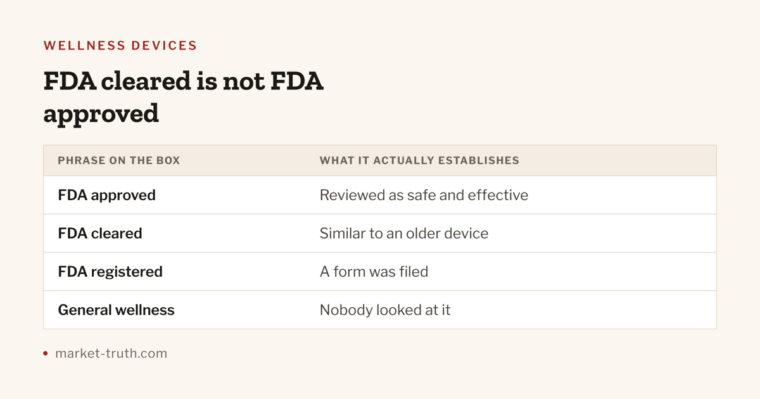
Those three phrases appear on wellness device packaging with roughly equal confidence and roughly zero equal meaning. One of them reflects a real review. One reflects a very different and much rarer review. One reflects a filing clerk. This page separates them, then shows you how to check any specific device yourself in about four minutes.
What does FDA cleared actually mean?
FDA cleared means the manufacturer submitted a 510(k) premarket notification and the FDA issued an order agreeing the device is substantially equivalent to a legally marketed predicate device. The FDA states plainly that a 510(k) is a notification, not an approval. The agency usually reaches a determination within 90 days.
Substantial equivalence is a comparison between two products, not a verdict on either one: it means the FDA agreed a new device is close enough to a device already on the market to be sold on the same terms.
Read that carefully, because the whole consumer misunderstanding lives inside it. The reference point is another product. It is not a placebo, not a control group, and not a clinical outcome. According to the FDA’s 510(k) page, the submitter’s job is to demonstrate equivalence to a predicate, and the FDA’s job is to agree or disagree with that demonstration.
So a clearance tells you a device is in a recognised category, has a defined intended use, and resembles something the FDA has already allowed on the market. It does not tell you the device produced a measured benefit in anyone. A chain of devices can each be cleared against the one before it without any of them ever being tested against nothing at all.
How is FDA approved different from FDA cleared?
FDA approved refers to Premarket Approval, which the FDA calls “the most stringent type of device marketing application required by FDA”. PMA applies to Class III devices, the highest risk class. Approval requires the FDA to find sufficient valid scientific evidence to assure the device is safe and effective for its intended uses.
That sentence contains the words the 510(k) pathway does not contain: safe and effective. The FDA’s PMA page sets the standard as valid scientific evidence, judged against the device’s own claimed use, rather than against a competitor product.
Class III is where implanted and life-sustaining technology sits. It is not where consumer wellness hardware sits. If you are holding a product page for a red light mask, a percussive massager or a wearable ring, the odds that it went through PMA are effectively nil, and any page telling you it is “FDA approved” is either wrong or lying.
This is the single most useful discrimination on the page. Cleared and approved differ by one syllable in marketing copy and by an entire evidentiary regime in law.
What does “FDA registered” mean on a device or supplement?
Almost nothing about quality. The FDA states that “mere registration of an establishment or listing of a drug or device does not denote approval of the establishment, the drug or device”, and adds that it does not even mean the product may be legally marketed. Registration is an administrative filing obligation.
Device establishment registration runs annually under 21 CFR Part 807. Separately, facilities that manufacture, process, pack or hold dietary supplements for US consumption must register with the FDA under the Public Health Security and Bioterrorism Preparedness and Response Act before beginning operations. Both are filings. Neither is a review.
Read the FDA’s own consumer update on the question and the position is blunt: the agency does not approve health care providers, and it does not independently approve manufacturing facilities. So “manufactured in an FDA registered facility” establishes that an address is on a list. It establishes nothing about what came out of the building.
This is the phrase I would treat with the most suspicion, precisely because it is the one that sounds most like a credential and carries the least. A company that had a clearance would say “cleared”. A company that says “registered” is usually telling you it has nothing better to say.
Which wellness devices are not reviewed by the FDA at all?
A large share of the category. Under the general wellness policy, the FDA’s device centre, CDRH, does not intend to examine low risk general wellness products to determine whether they are devices at all, or whether they comply with premarket review and post-market requirements including registration and listing, 510(k), labeling, Quality System and MDR obligations.
CDRH defines a general wellness product by two factors: it is intended only for general wellness use, and it presents a low risk to the safety of users and other persons. The guidance is what allows an enormous consumer category to exist outside premarket review entirely.
In practice that covers most sauna blankets, grounding and earthing sheets, percussive massage guns sold for general recovery, and the majority of consumer red light panels sold for “wellness” rather than a named condition. Some red light devices genuinely do hold clearances for specific indications, which is why the wording on each product matters more than the category, and why we ran a separate check on whether red light panels are cleared or approved.
Software went further. Section 3060(a) of the 21st Century Cures Act removed from the statutory device definition those software functions intended for maintaining or encouraging a healthy lifestyle, where they are unrelated to the diagnosis, cure, mitigation, prevention or treatment of disease. That is the legal reason sleep scores, readiness scores and stress scores can ship without anyone verifying them, a gap we tested directly in our look at smart ring sleep tracking accuracy.
| Pathway | What FDA reviewed | What the marketing may say | What it does NOT tell you |
|---|---|---|---|
| PMA approved (Class III) | Valid scientific evidence that the device is safe and effective for its intended uses | “FDA approved” | That it works for any use outside the approved indication |
| 510(k) cleared | That the device is substantially equivalent to a legally marketed predicate | “FDA cleared”, “FDA registered and cleared” | That the device or its predicate was ever shown to produce a benefit |
| Registered and listed | Nothing. An establishment filing under 21 CFR Part 807, renewed annually | “FDA registered”, “made in an FDA registered facility” | Approval of the firm, the facility or the product, or that it may be legally marketed |
| General wellness (unreviewed) | Nothing. CDRH does not intend to examine these products | “Wellness device”, “drug free”, “clinically inspired” | Whether it is even a device in law, or meets any premarket requirement |
| Dietary supplement | Nothing premarket. FDA lacks authority to approve supplements before marketing | “FDA registered facility”, structure/function claims | Whether the ingredient works, or whether FDA has seen the substantiation |
Supplements sit in the table because the same words appear on both product types. The FDA states that under DSHEA it does not have authority to approve dietary supplements before they are marketed, and NIH’s Office of Dietary Supplements states the agency does not determine whether supplements are effective before they are sold.
Why does a cleared device advertise a claim it was never cleared for?
Because clearance attaches to a narrow Indications for Use statement, and the marketing page does not. A 510(k) clears one defined use. The website then adds energy, recovery, immunity, inflammation, focus and sleep, none of which were reviewed. The clearance is real. Its scope is much smaller than the sentence that cites it.
Once a claim leaves the cleared indication, it stops being an FDA question and becomes an FTC question. The FDA is generally responsible for safety, quality and labeling; the FTC is generally responsible for advertising. Both can bring enforcement actions, a division we unpack in our guide to who actually polices health claims.
The FTC’s Health Products Compliance Guidance defines advertising to include packaging and labeling, brochures, websites, social media, influencer marketing, press releases and promotion made indirectly through healthcare practitioners. Health benefit claims require substantiation in the form of competent and reliable scientific evidence, and the guidance states that as a general matter this will need to be randomized, controlled human clinical testing.
Watch for “clinically proven” alongside a clearance badge. That phrase is not defined or approved by any US agency, and the FTC’s rule is that marketers must have at least the level of support they claim to have. Stacking it next to a K number implies the FDA reviewed proof of effect. It did not.
How can I check a device’s real FDA status myself?
Two free FDA databases settle it. The 510(k) Premarket Notification database tells you whether a clearance exists and exactly what it covers. The Establishment Registration and Device Listing database tells you only whether a company filed. Checking both takes a few minutes and beats any badge on a product page.
- Open the 510(k) Premarket Notification database and search by device name, or by applicant name if you know the manufacturer. Applicant search is more reliable, because brands rename products constantly.
- Read the K number in the results. It is the letter K followed by six digits, and the first two digits are the submission year. No K number anywhere means no clearance.
- Open the 510(k) summary linked from the record. This is the document the submitter filed, not a marketing asset.
- Find the Indications for Use statement. This single paragraph is the entire legal scope of the clearance.
- Put that paragraph next to the product’s marketing page and read them side by side. Every benefit on the marketing page that is absent from the Indications for Use is an unreviewed claim.
- If nothing appears, search the Establishment Registration and Device Listing database. A hit there and nowhere else means the company is registered and nothing more.
This is the check we run before publishing any device verdict, and the method is documented in how we research. If a device is being considered for a diagnosed medical condition, that decision belongs with a licensed clinician, not with a database lookup.
What should I actually take from the words on the box?
Rank them. FDA approved carries real evidentiary weight and is almost never true of wellness hardware. FDA cleared carries limited weight: it confirms a reviewed intended use and nothing about benefit. FDA registered carries essentially none. Anything else on the box is invented vocabulary.
| Phrase on the box | What it establishes | What it does not establish |
|---|---|---|
| FDA approved | A PMA finding of sufficient valid scientific evidence that the device is safe and effective for its intended uses | Any benefit outside the approved indication |
| FDA cleared | A 510(k) order of substantial equivalence to a legally marketed predicate, for one defined indication | That anyone measured a benefit, in that device or its predicate |
| FDA registered | An establishment filing exists. FDA states registration does not denote approval of the establishment or the product | Product quality, legality of marketing, or any review |
| FDA registered facility | An address appears on an FDA list, renewed annually under 21 CFR Part 807 | What was made there, or how well |
| Manufactured in an FDA registered facility | The same filing, one step further removed, since the seller may not own the facility | Anything at all about the product itself |
| FDA compliant | Nothing. It is a self-assertion with no FDA action behind it | Everything |
The judgement call: “FDA registered” and its variants are the weakest of these terms and, in a consumer context, close to meaningless. They exist because they sound like the strong terms. Treat their presence as evidence a product has no clearance, since a company holding a K number would name it.
The strongest signal is not a phrase at all. It is a K number you can open, attached to an Indications for Use statement that matches what you are actually buying the device for. When those three things line up, the label is telling the truth. When they do not, the box is doing the work the evidence could not.
Questions readers ask
What is a K number and where do I find it?
A K number is the identifier the FDA assigns to a 510(k) submission: the letter K followed by six digits, the first two being the year. You find it by searching the FDA's 510(k) Premarket Notification database by device or applicant name.
Does FDA clearance cover the whole product or only one use?
Only one use. A 510(k) clears a specific Indications for Use statement. Benefits advertised outside that statement were never reviewed by the FDA, even though the clearance itself is genuine and the badge is accurate.
Who polices a wellness device's advertising claims?
The FTC. The FDA is generally responsible for safety, quality and labeling, while the FTC is generally responsible for advertising, and its definition of advertising covers packaging, websites, social media and influencer marketing. Both agencies can bring enforcement actions.
Are dietary supplements cleared or approved by the FDA?
Neither. Under DSHEA the FDA does not have authority to approve dietary supplements before they are marketed, and the agency states that many supplements can be sold without the FDA even being notified that they exist.
Sources
- FDA, Premarket Notification 510(k)
- FDA, Premarket Approval (PMA)
- FDA Consumer Update, Is It Really FDA Approved?
- FDA, General Wellness: Policy for Low Risk Devices
- FDA, 510(k) Premarket Notification Database
- FDA, Establishment Registration and Device Listing Database
- FTC, Health Products Compliance Guidance
- NIH ODS, Dietary Supplements: What You Need to Know
Primary sources last checked September 5, 2026.
Every check in this guide
-
Is red light therapy FDA approved or FDA cleared?
We pulled the actual 510(k) records for consumer red light panels and compared each cleared indication with what the product homepages claim.