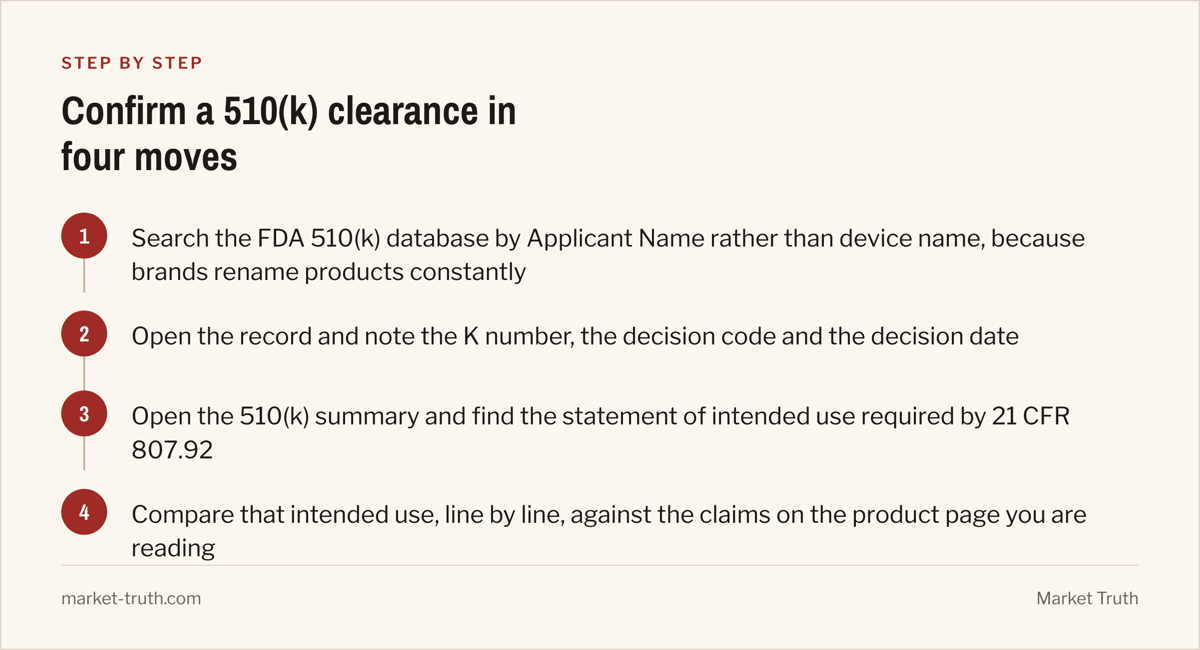
You can verify an FDA clearance yourself in about four minutes, free, with no account. Search the FDA 510(k) Premarket Notification database by applicant name, find the K number, open the 510(k) summary, and read the statement of intended use. Then compare that line against the product's marketing page. Most "FDA cleared" wellness devices fail at that last step, not the first.
How do you check if a device is actually FDA cleared?
Go to the primary record rather than the seller’s badge. The FDA publishes every 510(k) decision in a searchable public database at accessdata.fda.gov, with no login. A clearance that exists will be in there. A clearance that is not in there does not exist.
A 510(k) is a premarket notification, not an approval. The FDA describes it as a submission demonstrating that a device is substantially equivalent to a legally marketed predicate, after which the agency issues an order clearing the device, usually within 90 days (FDA, Premarket Notification 510(k)).
The distinction is not pedantry, it is written into the regulation. Under 21 CFR 807.97, a substantial equivalence determination “does not in any way denote official approval of the device”, and any representation creating an impression of official approval “is misleading and constitutes misbranding”.
Where is the FDA 510(k) database and what do you search?
The 510(k) Premarket Notification database sits under FDA Home, Medical Devices, Databases. The search form offers 510(k) Number, Applicant Name, Device Name, Product Code, Panel, Decision, and a Decision Date range. You do not need to know any regulatory jargon to use it.
Start with Applicant Name and enter the company, not the product. Leave every other field blank. The result set is every clearance that company holds, which is usually a short list you can read in full. From there you are matching a device description to the thing in your shopping cart.
Pay attention to the Decision column. Values include plain substantial equivalence, but also “SUBST EQUIV FOR SOME INDICATIONS”, which means the agency cleared a narrower set of uses than the submission requested. That is a signal worth ten minutes of your time, because it tells you the FDA drew a line somewhere the marketing may have redrawn.
Why search by applicant name instead of device name?
Because the consumer-facing brand name and the regulatory device name are frequently different, and the consumer one changes more often. A company rebrands a product for a new campaign, and the database still carries the name filed at submission. Search the device name and you get nothing, which looks identical to no clearance existing.
Applicant name is more stable. It is the legal entity that filed, and it changes only on acquisition or restructuring. If the brand you are checking is owned by a parent company, search the parent as well. Distributors and marketers frequently sell a device cleared under a manufacturer’s name.
If the applicant search returns nothing, widen it once by product code using the Device Classification database to find the code for that device type, then filter that code by decision date. If a clearance for that company still does not surface, treat the badge on the website as unsupported.
What is in a 510(k) summary, and what if there is not one?
The summary is where the real information lives, and its contents are mandated. Under 21 CFR 807.92, every 510(k) summary must contain the submitter’s name, the device name, an identification of the predicate device, a description of the device, and a statement of the intended use.
It must also, where substantial equivalence rested on performance data, include a brief discussion of the nonclinical and clinical tests relied on, and the conclusions drawn from them. That section tells you whether any human testing happened at all.
Some records have no summary. Submitters may instead file a 510(k) statement under 21 CFR 807.93, certifying that they will make the safety and effectiveness information available within 30 days of a written request from any person. That request right is yours. In practice, a missing summary means the public record is thinner and you should weight the marketing claims accordingly.
What is the Indications for Use statement and why does it matter?
The intended use statement is the only description of the device the FDA actually reviewed. Everything else on a product page is the company’s own writing. When the two do not match, the clearance is being borrowed to support a claim it never covered, and that is the single most common failure in wellness device marketing.
Read it literally. A device cleared for temporary relief of minor muscle pain has not been cleared for improving sleep, reducing inflammation, or supporting recovery, however adjacent those sound. Regulation 807.92(a)(5) requires the summary to describe the conditions the device will diagnose, treat, prevent, cure or mitigate, and the intended patient population.
Print the intended use sentence and the marketing headline side by side. If the headline names a condition, an outcome or a population absent from the cleared statement, you have found the gap. That is the same comparison this site runs on red light therapy clearance claims.
| What your search returned | What it proves | What it does not prove |
|---|---|---|
| A K number in the 510(k) database | FDA found the device substantially equivalent to a predicate | That FDA found it safe and effective, or approved it |
| A hit in registration and listing only | The firm filed its establishment paperwork | Any FDA review of the device whatsoever |
| A PMA approval number | FDA found valid scientific evidence of safety and effectiveness | That the claim on the ad matches the approved use |
| Nothing at all | No public FDA record under that name | That the device is illegal, since some wellness products are outside the policy |
What does it mean if the company only appears in the registration database?
It means they filled in a form. The Establishment Registration and Device Listing database carries its own warning on the search page: “Registration of a device establishment, assignment of a registration number, or listing of a medical device does not in any way denote approval of the establishment or its products by FDA.”
Device establishment registration is an annual obligation under 21 CFR Part 807. It is an administrative filing, and the FDA states flatly that “mere registration of an establishment or listing of a drug or device does not denote approval” and does not mean a product may be legally marketed (FDA, Is It Really “FDA Approved”?).
So “FDA registered” on a box is the weakest signal in this whole article, and it is deliberately chosen to sound like the strongest. The registered versus approved distinction is worth reading in full before you buy any device that leans on it.
Does an FDA clearance mean the agency agrees the device works?
No. Clearance means equivalence to something already on the market, and the predicate chain can run back decades. Approval is the higher bar. The FDA describes Premarket Approval as “the most stringent type of device marketing application”, requiring the agency to find sufficient valid scientific evidence that the device is safe and effective for its intended use (FDA, Premarket Approval).
Many consumer wellness gadgets have neither, legitimately. Under the CDRH general wellness policy, the agency does not intend to examine low-risk general wellness products for compliance with registration, 510(k), labelling or quality system requirements (FDA, General Wellness: Policy for Low Risk Devices). A blank search result is not automatically damning, but it does mean no agency looked.
My judgement: the Indications for Use comparison is the highest-value check on this list, higher than confirming the K number exists, because a real clearance stretched past its cleared use is far more common than a fabricated one. Nothing here is medical advice, and a clinician should guide decisions about treating a medical condition. Background on the wider distinction is in FDA cleared versus approved, and our sourcing rules are in how we research.
Questions readers ask
What does a K number look like?
A 510(k) number is the letter K followed by six digits, where the first two indicate the year of submission. It appears in the database record and is the identifier to quote when asking a seller for their clearance.
Can I request the full 510(k) file if there is no summary?
Yes. Under 21 CFR 807.93 the submitter certifies it will make all safety and effectiveness information in the notification available within 30 days of a written request by any person, excluding trade secrets and patient identifiers.
Is a De Novo authorisation the same as a clearance?
No. De Novo is a separate pathway for novel low to moderate risk devices with no predicate, and it has its own database linked from the 510(k) search page. A De Novo grant is not a 510(k) clearance.
Why do two devices with the same clearance make different claims?
Because marketing copy is written after the fact and is not reviewed alongside the submission. The cleared intended use statement is fixed, so compare each product page against that statement rather than against the competitor.
Who polices device advertising claims?
The FTC generally handles advertising, and its Health Products Compliance Guidance covers health equipment, diagnostic tests and health apps alongside supplements. The FDA and FTC can both bring enforcement actions.
Sources
- FDA, 510(k) Premarket Notification database
- FDA, Establishment Registration and Device Listing database
- 21 CFR 807.92, Content and format of a 510(k) summary
- 21 CFR 807.97, Misbranding by reference to premarket notification
- FDA, Premarket Notification 510(k)
- FDA, Premarket Approval (PMA)
- FDA, Is It Really "FDA Approved"?
- FDA, General Wellness: Policy for Low Risk Devices
Primary sources last checked September 5, 2026.

About Erin Delaney
Erin Delaney is a health science journalist who has spent nine years reading the documents behind health product marketing. She covers dietary supplements, wellness devices and the advertising rules that govern them, working from FDA and FTC filings, NIH Office of Dietary Supplements fact sheets, USP and NSF standards and the primary research literature rather than press releases or vendor claims. Her interest started with one question that nobody on a product page ever answers: if the bottle says clinically proven, who actually checked, and against what? She is not a physician and does not give medical advice. Her job is to show you what the evidence says, and to be equally clear about where it runs out.
Related checks
-
Are copper compression sleeves proven to work?
Copper compression sleeves sell two claims as one product, and only the compression half has any trial evidence behind it worth grading.
-
Is red light therapy FDA approved or FDA cleared?
We pulled the actual 510(k) records for consumer red light panels and compared each cleared indication with what the product homepages claim.